Morals can be categorized as either secular or religious. Secular morality aims to create a moral code distinct from God and all other deities. Various justifications have been offered for the motivations behind morality. People are moral when seeking happiness or perfection, which is one explanation. Another contends that people are forced to uphold a particular code of behaviour by societal or political pressure. Another theory is that people become moral out of a sense of obligation. This taxonomy of morals also has a problem with its unclear definition of ethical knowledge. Is happiness, for instance, a mental, physical, or spiritual state?
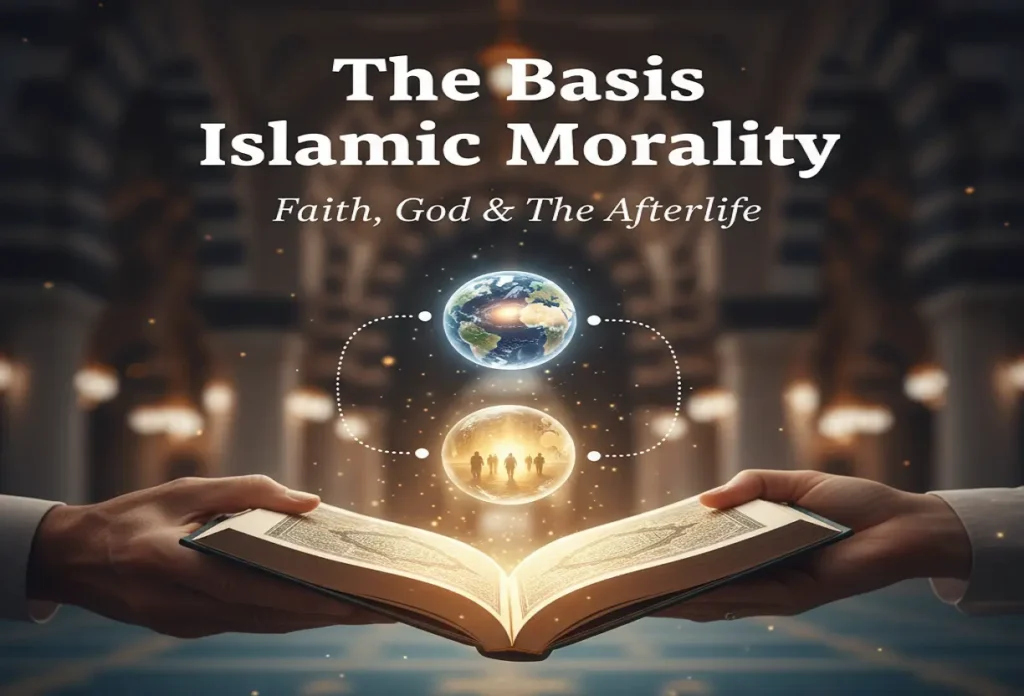
Regarding religious morality, it is primarily predicated on two ideas: the conviction that God is the universe’s Creator, and the belief that there will be an afterlife. Because the foundations of religious morality differ for each religion, the phrase “religious morality” is not consistently utilized.
Islam's view of God
A Muslim holds that God is this universe’s only Lord, Creator, and Sustainer and that He is perfect in every way. Only a few of God’s divine qualities are absolute and perfect knowledge, absolute life, perfection, wisdom, power, kindness, and justice. A Muslim’s connection with God is a loving, conscious, and willing surrender to God’s will. This closeness is described in one verse of the Qur’an: “And We are nearer to him than his jugular vein (by our knowledge)” (Qaf 50:16). Islam emphasizes both the absolute transcendence and perfection of God along with His direct involvement with creation, in contrast to some Hellenic intellectual views, which argue that God is both transcendent and aloof from this cosmos.
Other Religious Communities' Differences
One ultimate sovereign will (God’s will) is naturally believed in by Muslims who believe in a supreme and universal God whose divine characteristics are not shared by any of His creatures. This creates stability and certainty because there is just one supreme ideal to aspire to. For instance, some individuals refer to natural events as “laws of Mother Nature”. Muslims hold that God established laws in nature, which are unchanging and orderly. This leads to the conclusion that the Will responsible for creation must be singular and consistent.
Polytheism is the belief in multiple supreme deities, in other beings of God who share some or all of His divine characteristics, or in lesser deities who mediate between mankind and the Supreme Deity. All of this encourages the concept that there are multiple ideal or ultimate sources of knowledge, which would result in chaos in the cosmos. Due to this, the Qur’an is very clear when it states what it means when it says: (Had there been other gods except Allah therein (in the heavens and earth), then surely both would have been destroyed. Above all that people credit to him, praise be to Allah, the king of the throne! 21:22 in Al-Anbiya
Compared to the God of the Bible The distinction between Islamic monotheism and other kinds of polytheism is unquestionably smaller than the difference between Islamic monotheism and the concept of God as presented in the Bible. It’s a prevalent misconception that the Islamic view of monotheism is either an expansion of or based on the biblical view of God. Numerous non-Muslim academics have noted that God appears to have had a superhuman aspect among the early Israelites. After creating the heavens and the earth, God is said to have needed to rest in the Book of Genesis, He is said to have been moving around the garden as Adam and Eve heard the sound of his footsteps. It also shows God making errors and getting corrected by others. In the Tower of Babel tale, God is shown to be envious of human power. The Bible claims that as people began constructing the Tower of Babel, God changed their language to prevent them from communicating with one another because He thought they were growing to be very intelligent and strong. The Bible says that this is what led to the diversity of languages. When the phrase “God of Israel” is frequently used, it conveys that He is a tribal deity.
In contrast to Islam’s focus on God’s transcendence, complete independence from all human flaws, and the idea that He is not human-like since He is not “physical” in the sense that He can be sensed, these portrayals of God that show Him as a superhuman are inaccurate. In the Qur’an, God is described as the “Lord of the universe” in the first chapter (Al-Fatihah 1:2) and as the “Lord of mankind” in the last chapter (An-Nas 114:1), if the Islamic understanding of God is contrasted to the Biblical concept of the “God of Israel” ( ). The word “God of Arabs”, or “God of Muslims” or “God of any ethnic group” does not appear in the Qur’an; instead, God is the God of all people.
Ethics' Implications
Islam’s view of God has significant implications for its ethical framework. How can a religion be the ultimate, sole, and unchanging source of ethics, for instance, when flaws, faults, or contradictions taint its conception of the highest ideal and its perfect monotheism, as in other religions? A feeling of loving, conscious, and deliberate submission to God, which means “Islam” as a faith, results from accepting God as the single Bestower of everything we have. As a result, the person develops a sense of absolute commitment to God alone.
God knows what is in our hearts and minds, and we cannot hide anything from Him or deceive Him if we believe in Him, His Perfection and divine attributes, that He is the only power in this universe, and that He is the Ultimate God with the full, perfect, and complete knowledge. Knowing that you cannot get away with wrongdoing if humans do not detect you since God is the All-Encompassing leads to increased self-discipline. Any ethical or moral code of conduct must be based on this discipline.
Keeping the Two Worlds in Balance
Muslims deeply believe in the afterlife, yet Islam also teaches that this life should not be neglected because of this conviction. For instance, in Al-Qasas 28:77, the Qur’an says, “But seek, with the (wealth) which God has bestowed on thee, the Home of the Hereafter, nor forget thy portion in this world: but do good, as God has been good to thee, and seek not (Occasion for) mischief in the land: For God does not love those who make mischief.” This is speaking to Qarun, a wealthy contemporary of Moses.
Islam teaches the belief in the Hereafter, and in retribution and reward Still, it does not imply that renunciations of this life may achieve the ultimate level of righteousness or piety. Instead, there should be a balance between daily activity and death. Muslims are told to prepare for it by earning “credit” for salvation through their efforts to atone for transgressions and advance justice and peace while they are still on earth.
Heavy and Light Letters in Arabic (Tafkhīm and Tarqīq): A Complete Beginner-to-Advanced Guide Introduction: Why Heavy and Light Letters Matter When a...
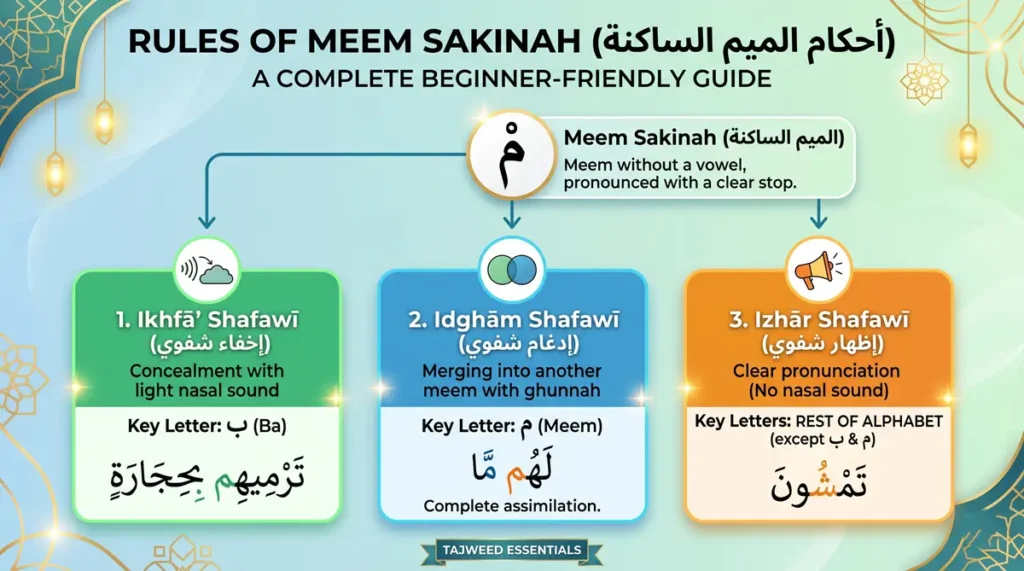
Rules of Meem Sakinah (أحكام الميم الساكنة): A Complete Beginner-Friendly Guide Meem Sakinah (الميم الساكنة) refers to the Arabic letter م (meem) that...