
If you have any questions
Don’t hesitate to reach out to us via live chat or email!
One of the most important aspects of properly reciting the Qur’an is Tajweed , the science that teaches Muslims how to pronounce Qur’anic letters correctly and beautifully as they were revealed to the Prophet Muhammad ﷺ.
Among the foundational topics of Tajweed is understanding the rules of Noon Sakinah (نْ) and Tanween (ً ٍ ٌ). These rules determine how the sound of the letter Noon (ن) should be pronounced depending on the letter that comes after it.
If you have ever listened to skilled Qur’an reciters, you may have noticed that sometimes the Noon sound is pronounced clearly, while other times it blends into the next letter or changes its sound. These variations are not random , they follow specific Tajweed rules.
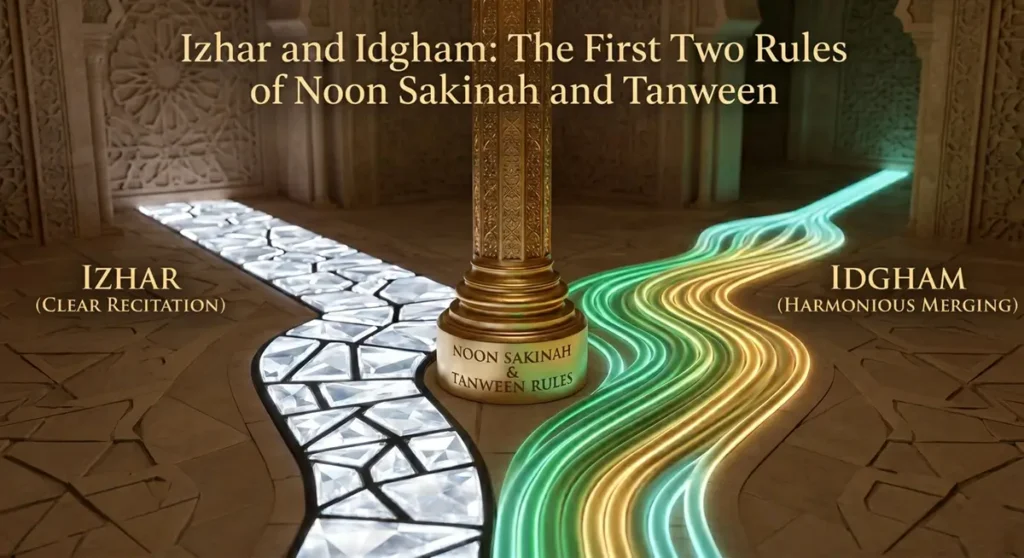
There are four main rules of Noon Sakinah and Tanween, but in this article we will focus in depth on the first two rules:
These two rules form the foundation of understanding Noon Sakinah and Tanween, and mastering them greatly improves Qur’anic recitation.
This comprehensive guide will explain:
This article is written especially for beginners and new Muslims, so every concept will be explained step-by-step.
In This Article
ToggleBefore discussing the rules themselves, we must first understand what Noon Sakinah and Tanween actually are.
What is Noon Sakinah (النون الساكنة) ?
Definition:
Noon Sakinah is the letter Noon (ن) that has a sukoon (ْ) over it, meaning it has no vowel and is pronounced with a natural “n” sound.
Example
نْ
Examples in Qur’anic words:
When reciting, the Noon Sakinah sound is pronounced without any vowel movement, simply as “n”.
Tanween refers to the double vowel marks at the end of nouns in Arabic.
These are:
Tanween produces a sound similar to Noon Sakinah, adding an “n” sound at the end of a word.
Examples
كِتَابٌ
(kitaabun)
عَلِيمًا
(ʿaleeman)
هُدًى
(hudan)
Notice that Tanween sounds like a hidden Noon at the end of the word.
Arabic pronunciation changes depending on the letters that come next.
For example, in many languages’ sounds merge or change to make speech smoother.
Similarly, in Qur’anic recitation:
These changes create the four Tajweed rules:
In this article we will explore the first two rules in great depth.
Definition of Izhar
Izhar literally means “clarity” or “making something apparent.”
In Tajweed, Izhar means:
Pronouncing the Noon Sakinah or Tanween clearly without merging or hiding it when followed by certain letters.
The Noon sound is pronounced fully and distinctly.
Izhar occurs when Noon Sakinah or Tanween is followed by one of six letters.
These letters are known as the throat letters (حروف الحلق) because they are pronounced from the throat.
The six letters are:
ء
ه
ع
ح
غ
خ
These letters are often memorized using the phrase:
أخي هاك علما حازه غير خاسر
The reason for Izhar is the distance between the articulation points.
The Noon sound comes from the tip of the tongue touching the upper gums, while the Izhar letters come from the throat.
Because these articulation points are far apart, the sounds cannot merge smoothly.
Therefore, the Noon sound must be pronounced clearly.
When Izhar occurs:
Example pattern:
نْ + throat letter
or
Tanween + throat letter
Example 1
مِنْ هَادٍ
The Noon Sakinah is followed by ه.
The Noon is pronounced clearly:
min hād
Example 2
مِنْ عِلْمٍ
The Noon is followed by ع.
It remains clear:
min ʿilm
Example 3
عَلِيمٌ حَكِيمٌ
Tanween followed by ح.
The n sound remains clear.
Example 4
سَمِيعٌ عَلِيمٌ
Tanween followed by ع.
Again, the Noon sound is pronounced clearly.
Some scholars divide Izhar into three subcategories depending on the throat position.
ء
ه
Example:
مِنْ هَادٍ
ع
ح
Example:
مِنْ عِلْمٍ
غ
خ
Example:
مِنْ خَيْرٍ
Many beginners make mistakes when learning Izhar.
Some learners accidentally merge the Noon with the next letter.
Example mistake:
min-hād becomes mi-hād.
The Noon disappears, which is incorrect.
Izhar does not require heavy nasal sound (ghunnah).
The Noon should be natural and clear.
This often happens when reading quickly.
Correct recitation must maintain the Noon sound clearly.
Tip 1: Practice slowly
Slow recitation helps you pronounce each letter clearly.
Tip 2: Identify throat letters
Memorize the six letters until recognition becomes automatic.
Tip 3: Listen to skilled reciters
Listening helps train your ear.
Famous reciters known for clear Tajweed include:
Tip 4: Recite with a teacher
Tajweed is traditionally learned through oral transmission.
A teacher can immediately correct mistakes.
Definition of Idgham
Idgham means “to merge” or “to insert something into something else.”
In Tajweed, Idgham means:
Merging the Noon Sakinah or Tanween into the following letter so that they become one combined sound.
This merging makes recitation smoother and more natural.
There are six Idgham letters.
They are:
ي
ر
م
ل
و
ن
These letters are often remembered using the word:
يرملون
Idgham is divided into two categories.
Occurs with the letters:
ي
ن
م
و
These letters are remembered as:
ينمو
Occurs with the letters:
ل
ر
Definition
When Noon Sakinah or Tanween is followed by ي ن م و, the Noon sound merges with the next letter while producing a nasal sound (ghunnah).
Example 1
مَنْ يَعْمَلْ
Noon followed by ي
Pronounced:
may-yaʿmal
Example 2
مِنْ مَالٍ
Noon followed by م
Pronounced with nasal merging.
Example 3
هُدًى وَرَحْمَةً
Tanween followed by و
Definition
When Noon Sakinah or Tanween is followed by ل or ر, the Noon merges completely without nasal sound.
Example 1
مِنْ رَبِّهِمْ
Pronounced:
mir-rabbihim
Example 2
مِنْ لَدُنْهُ
Pronounced:
mil-ladunhu
Example 3
غَفُورٌ رَحِيمٌ
Tanween merges into ر.
Key Difference
Type | Letters | Nasal Sound |
Idgham with Ghunnah | ي ن م و | Yes |
Idgham without Ghunnah | ل ر | No |
Idgham only occurs when:
Noon Sakinah or Tanween is at the end of one word and the Idgham letter is at the beginning of the next word.
Example:
مِنْ رَبِّهِمْ
However, if both letters occur within the same word, Idgham does not occur.
Example:
دُنْيَا
Even though ن is followed by ي, Idgham does not apply because it is one word.
Arabic is a language of fluid pronunciation.
Idgham helps:
This beauty of sound is one of the miraculous aspects of Qur’anic recitation.
Feature | Izhar | Idgham |
Meaning | Clear pronunciation | Merging |
Noon sound | Fully pronounced | Merged |
Letters | ء ه ع ح غ خ | يرملون |
Nasal sound | No | Sometimes |
Purpose | Clarity | Smoothness |
Learning Tajweed requires consistent practice.
Step 1: Memorize the letters
Know instantly:
Izhar letters
Idgham letters
Step 2: Identify Noon Sakinah and Tanween
Look for:
نْ
ً ٍ ٌ
Step 3: Check the next letter
The following letter determines the rule.
Step 4: Apply the correct pronunciation
Clear sound → Izhar
Merged sound → Idgham
Step 5: Recite Qur’an regularly
Even 10–15 minutes daily improves Tajweed greatly.
Rules such as Izhar (clear pronunciation) and Idgham (merging) can appear very technical when presented in Tajweed books. Learners sometimes imagine that scholars invented these rules later to make Qur’anic recitation more complex.
However, the reality is very different.
The rules of Tajweed were not invented by scholars. Instead, they were observed, preserved, and explained by scholars after the time of the Prophet ﷺ. These rules reflect the natural pronunciation patterns of classical Arabic, the language spoken by the Arabs at the time the Qur’an was revealed.
In other words:
Before discussing linguistics, it is important to understand that the Qur’an was transmitted primarily through oral recitation.
The Prophet ﷺ taught the Qur’an directly to his companions.
They learned by listening carefully and repeating.
This process continued generation after generation through what scholars call:
التلقي والمشافهة
Meaning:
“Direct receiving and oral transmission.”
Through this method, Muslims preserved not only the words of the Qur’an, but also the exact way they were pronounced.
For the first generations of Muslims, Tajweed rules were not written in books.
The companions and early Arabs already knew the correct pronunciation instinctively, because it was their native language.
However, as Islam spread beyond Arabia, many new Muslims did not speak Arabic natively. This created a need to document the correct pronunciation.
This led to the development of Tajweed as a scientific discipline.
Modern linguistics studies how speech sounds are produced.
This field is known as phonetics.
Phonetics examines:
Interestingly, classical Arabic scholars analyzed these features over a thousand years ago.
They identified the makharij al-huruf (articulation points) and sifat al-huruf (characteristics of letters).
These principles explain why Izhar and Idgham occur.
In modern linguistics, Idgham is called:
assimilation
Assimilation occurs when one sound becomes similar to a nearby sound to make pronunciation easier.
This phenomenon occurs in many languages worldwide.
Example in English
Consider the phrase:
handbag
Many speakers pronounce it as:
hambag
The letter n changes toward m because of the following b.
This is exactly the same type of process seen in Arabic Iqlab and Idgham.
In Tajweed, Idgham occurs when the sound of Noon Sakinah or Tanween merges into the following letter.
For example:
مِن رَبِّهِم
Instead of pronouncing:
min rabbihim
It becomes:
mir-rabbihim
The Noon sound merges into the ر.
From a phonetic perspective, this happens because the tongue position for Noon and Ra are very close.
Merging the sounds makes speech smoother and more efficient.
Izhar is the opposite situation.
Izhar occurs when Noon is followed by throat letters:
ء ه ع ح غ خ
These letters are produced in the throat, while Noon is produced at the tip of the tongue.
Because these articulation points are far apart, assimilation is difficult.
Therefore, the Noon remains fully pronounced.
This explains Izhar from a purely phonetic perspective.
Yes.
Historical linguistic evidence shows that assimilation was common in classical Arabic speech.
Arabic poetry from the pre-Islamic era (before the Qur’an) already demonstrates these pronunciation patterns.
This indicates that Idgham was part of natural Arabic phonology.
Languages naturally evolve toward ease of pronunciation.
When two similar sounds meet, merging them reduces effort.
In Arabic speech, this made words flow smoothly.
For example:
مِنْ رَبِّهِم
If pronounced fully without merging, the transition between sounds would be slightly heavier.
Assimilation simplifies articulation.
When articulation points are far apart, merging sounds becomes difficult.
For example:
مِنْ هَادٍ
The sound n comes from the tongue.
The sound h comes from the throat.
Because these sounds are produced in very different places, assimilation does not occur.
Thus the Noon remains clear.
Scholars identified Tajweed rules by studying three main sources:
The companions carefully preserved the Prophet’s pronunciation.
The early scholars were themselves native Arabic speakers.
They recognized natural phonetic patterns.
Scholars studied articulation points and sound characteristics.
They then categorized the observed pronunciation patterns.

Remarkably, classical Islamic scholars developed phonetic analysis centuries before modern linguistics.
They carefully described:
Their analysis closely resembles modern phonetics.
For example:
Ghunnah corresponds to nasal resonance.
Makharij correspond to articulation points.
One might ask:
If these patterns were natural speech habits, why emphasize them so strongly in Qur’anic recitation?
The answer lies in preservation.
The Qur’an is not simply a written text.
It is a recited revelation.
Preserving the original pronunciation ensures that the Qur’an is recited exactly as it was revealed.
When discussing the rules of Izhar and Idgham, it is very beneficial to mention the famous classical Tajweed poem Tuhfat al‑Atfāl.
This short poem has been memorized by students of Qur’anic recitation for centuries because it summarizes the major Tajweed rules in a clear and rhythmic way. It was written by the Egyptian scholar Sulayman al‑Jamzuri, and it remains one of the most widely taught introductory texts in Tajweed.
In the poem, the author describes the rules of Noon Sakinah and Tanween, including Izhar and Idgham, in a concise and memorable form.
The author says:
فَالأَوَّلُ الإِظْهَارُ قَبْلَ أَحْرُفِ
لِلْحَلْقِ سِتٌّ رُتِّبَتْ فَلْتُعْرَفِ
Translation:
“The first rule is Izhar before six letters
of the throat, arranged — so know them.”
He then lists those letters in the next line:
هَمْزٌ فَهَاءٌ ثُمَّ عَيْنٌ حَاءُ
مُهْمَلَتَانِ ثُمَّ غَيْنٌ خَاءُ
Meaning:
“They are: Hamzah, then Hā’, then ʿAyn and Ḥā’,
followed by Ghain and Khā’.”
Later in the poem, the author explains the second rule:
وَالثَّانِ إِدْغَامٌ بِسِتَّةٍ أَتَتْ
فِي يَرْمَلُونَ عِنْدَهُمْ قَدْ ثَبَتَتْ
Translation:
“The second rule is Idgham, which occurs with six letters
gathered in the word Yarmalūn.”
The poem continues by explaining that Idgham has two types:
لَكِنَّهَا قِسْمَانِ قِسْمٌ يُدْغَمَا
فِيهِ بِغُنَّةٍ بِيَنْمُو عُلِمَا
Translation:
“But it is divided into two categories:
one in which merging occurs with ghunnah, known as ‘Yanmu.’”
The letters of Idgham with Ghunnah are gathered in the word:
ينمو
Then the poet continues:
إِلَّا إِذَا كَانَا بِكِلْمَةٍ فَلَا
تُدْغِمْ كَدُنْيَا ثُمَّ صِنْوَانٍ تَلَا
Meaning:
“Except when they occur in the same word —
then do not merge them, like in the words dunyā and ṣinwān.”
This verse teaches an important condition:
Idgham generally occurs between two words, not inside the same word.
وَالثَّانِ إِدْغَامٌ بِغَيْرِ غُنَّةٍ
فِي اللَّامِ وَالرَّا ثُمَّ كَرِّرَنَّهُ
Translation:
“The second type of Idgham is without ghunnah,
and it occurs in the letters Lām and Rā’.”
Thus:
Tuhfat al-Atfāl became one of the most famous Tajweed poems because it helps students memorize rules easily.
Instead of memorizing long explanations, students memorize short poetic lines that summarize the rules.
For example:
These memory aids help students recall the rules quickly during recitation.
Reciting the Qur’an correctly is not only a linguistic skill — it is an act of worship.
Allah says in the Qur’an:
وَرَتِّلِ الْقُرْآنَ تَرْتِيلًا
“And recite the Qur’an with measured recitation.”
(Qur’an 73:4)
The Prophet ﷺ also said:
“The one who recites the Qur’an skillfully will be with the noble righteous scribes.”
(Sahih al-Bukhari and Sahih Muslim)
This shows that learning proper recitation is a highly rewarded act of worship.
Are Izhar and Idgham mandatory in recitation?
Yes. These rules are part of Tajweed, which preserves the correct pronunciation of the Qur’an.
Do beginners have to perfect Tajweed immediately?
No. Scholars emphasize gradual learning. A beginner should focus on improvement over time, not perfection instantly.
Is Tajweed required for prayer?
For prayer to be valid, one must recite Surah Al-Fatihah correctly enough that meanings are not distorted.
However, learning Tajweed improves recitation and is highly recommended.
The rules of Noon Sakinah and Tanween are foundational elements of Tajweed.
The first two rules are:
Izhar (Clear Pronunciation)
Occurs when Noon Sakinah or Tanween is followed by:
ء ه ع ح غ خ
The Noon sound is pronounced clearly without merging.
Idgham (Merging)
Occurs when Noon Sakinah or Tanween is followed by:
ي ر م ل و ن
The Noon sound merges with the next letter.
Two types exist:
Tajweed may seem complex at first, but with practice, patience, and guidance, it becomes natural.
Every effort spent learning the Qur’an is rewarded.
As the Prophet ﷺ said:
“The best among you are those who learn the Qur’an and teach it.”
(Sahih al-Bukhari)


If you have any questions
Don’t hesitate to reach out to us via live chat or email!