Ayat Academy

New chapter after Ramadan

chapter after Ramadan

It is only natural for us to feel down after Ramadan, sorrowful, and sometimes even regretful as the month of Ramadan ends and leaves us. We now completely appreciate what Allah (swt) says to us in Surah al-Baqarah (2:184):

أَيَّامًۭا مَّعْدُودَٰتٍ 

That fasting only lasts for a select number of predetermined days. It seems like yesterday that the moon was first observed and that we were given this month of honor. 

When al-Hafidh Ibn Rajab said, “How can a believer not shed tears at the departure of Ramadan, when he doesn’t even know whether we ‘ll be alive for its return or not?” he succinctly summed up these feelings of loss.1

However, we should use these emotions to make positive changes in our lives. The following verse from Surah al-Baqarah tells us:

“O you who have believed, decreed upon you is fasting as it was decreed upon those before you that you may become of the people of taqwa.” [Suarh Al-Baqarah 2;183]

At a time when we most need it, Allah gives us the opportunity to develop ourselves and emerge as better people throughout Ramadan. to grow in our relationship with God and obedience to Him. This modification and training include the fact that they are long-term changes that contribute to growth rather than abrupt changes. 

Legends from the past are reported to have responded, “How evil is a person who do not know Allah subnahu wa ta’la (glorified and exalted be He) except in Ramadan,” when asked about people who would return to their pre-Ramadan status as soon as it ended.

One of the righteous forefathers, Bishr al-Hafi, was asked a comparable query and responded as follows:

“How awful it must be for people to only be aware of Allah during Ramadan. A person is righteous if they diligently work and pray during the entire year.”

“Whoever fasts during the month of Ramadan and he says to himself that he will return to sinful disobedience after Ramadan is over, his fasting is rejected,” said Ka’b ibn Malik, ra’yAllahu ‘anhu (may Allah be pleased with him).

We must understand that the end of Ramadan does not mark “the end” of our spiritual development; rather, it marks the start of a brand-new chapter in our lives. We asked Allah Subhana Wa Ta’la (Glorified and Exalted be He) for forgiveness during this month, and insha’Allah, He has forgiven us, giving us a new base to build on for the upcoming year. 

Up to the last moment we leave on this planet, we should keep trying and giving it our all. not only during the holy month of Ramadan. There is an uplifting story about the time Imam Ahmad’s son Abdallah asked his father a very lovely inquiry. 

“Abi, when will we ever relax?” he asked. 

His father, one of history’s greatest scholars and an example we may all follow, responded in a nutshell. “With the first step we take into Jannah,” he remarked, looking his son directly in the eye.

A senior scholar usually woke up an hour or two before Fajr to partake in qiyaam. Usually, he would prepare by setting the alarm as he was blind. Once, when he was in his late eighties, he came home late following an operation. When he arrived home, he set his usual alarms in preparation for the night. However, his wife changed the alarms. 

The Shaykh awoke an hour before Fajr and asked his wife, “Isn’t this the time to wake up?” The question, “Why didn’t my alarms go off?” responded to her “Yes” response. “I switched them off, I wanted you to rest as you just returned from an operation,” she said in response.

“Rest is in Jannah, not here,” the Shaykh remarked.

We’ll discuss ways to keep going on this trip and avoid the slump many of us have experienced after Ramadan. 

1. A compelling goal

The goal of one’s life becomes evident to a believer during Ramadan. They contemplate and absorb what it means to serve Allah. This change in focus occurs when we are aware of a significant window of opportunity for Allah’s acceptance. We know that duas are readily accepted, that our good acts are doubled and that we are given a more valuable night than a lifetime’s worth of worship. Ibn al Jawzi said, “By Allah, if it were said to the inhabitants of the graves, “Wish,” they would indeed wish for a day from Ramadan,” precisely because of this.

Goals outside of Ramadan

You might have discovered over Ramadan that there were particular reminders or ways of thinking about the faith that bolstered your imaan. Some people find that remembering death and having only a finite amount of time in this world helps them feel closer to Allah subnahu wa ta’la (glorified and exalted be He). For instance, Umar rayAllahu ‘anhu (may Allah have mercy on him) would wear a ring that read, “Death is more than just a sufficient reminder, O Umar.” This would be plenty to keep him steady and unwavering on his travels. Sufyan at-Thawri carried a piece of paper with the following message: 

He would look at it various times throughout the day, repeating the phrase “Sufyan! Remember that you shall stand before Allah.”

2. Shielding against Shaytaan outside Ramdan

Outside of the month of Ramadan, it is still possible to reduce the influence of Shaytaan in our daily life. Our dear Messenger has shared with us numerous recommended safeguards.

 (a) According to the Prophet Muhammad, “Whoever says:

لاَ إِلَهَ إِلاَّ اللَّهُ، وَحْدَهُ لاَ شَرِيكَ لَهُ، لَهُ الْمُلْكُ وَلَهُ الْحَمْدُ، وَهْوَ عَلَى كُلِّ شَىْءٍ قَدِيرٌ

“Except for Allah, Who has no partners, no one deserves worship. He is able to accomplish anything since He has dominion and the honor.

one hundred times will get the same reward as the one who freed ten slaves; and one hundred good deeds will be written in his accounts, and one hundred sins will be deducted from his accounts, and it will be a protection for him from Shaytaan on that day till night, and nobody will be able to do a better deed except the one who does more than him.” [Saheeh al-Bukhari 6403]

3. The optimum circumstances for goodness and the renunciation of faults

Although Ramadan offers us a unique opportunity—Laylat-ul-Qadr is not a night like that in the rest of the year—have you thought about the possibility that your desire to worship was sparked by learning these virtues rather than other times of the year? For instance, the first 10 days of Dhul Hijjah or every Friday, an Islamic holiday is known as Eid.12 Every Friday, there is a tremendous window of opportunity when Allah will grant His people any request they make of Him. It is discovered in the final Asr hour, right before Maghrib.

“Friday is the day of worship,” writes Ibn al Qayyim, “and its comparison to other days is like the comparison of the month of Ramadan to other months, and the hour in it is like the Night of Decree in Ramadan.”

Latest Articles

Heavy and Light Letters in Arabic (Tafkhīm and Tarqīq): A Complete Beginner-to-Advanced Guide
Heavy and Light Letters in Arabic (Tafkhīm and Tarqīq): A Complete Beginner-to-Advanced Guide Introduction: Why Heavy and Light Letters Matter When a...
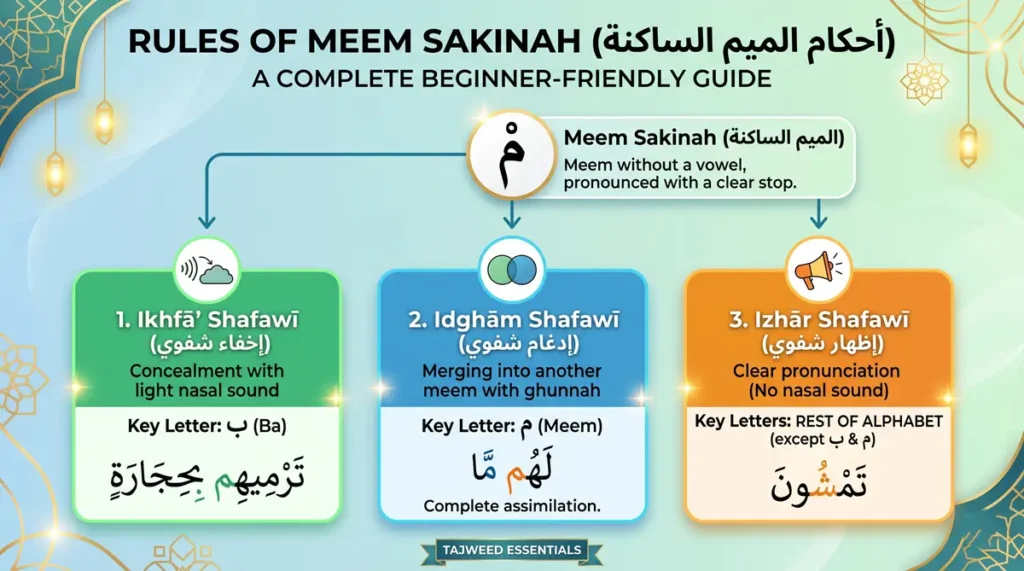
Rules of Meem Sakinah (أحكام الميم الساكنة): A Complete Beginner-Friendly Guide
Rules of Meem Sakinah (أحكام الميم الساكنة): A Complete Beginner-Friendly Guide Meem Sakinah (الميم الساكنة) refers to the Arabic letter م (meem) that...
The Rules of Ikhfa and Iqlab of Noon Sakinah and Tanween in Tajweed
The Rules of Ikhfa and Iqlab of Noon Sakinah and Tanween in Tajweed – Beginner’s Guide The Qur’an is the final revelation from Allah ﷻ to...

If you have any questions

Don’t hesitate to reach out to us via live chat or email!