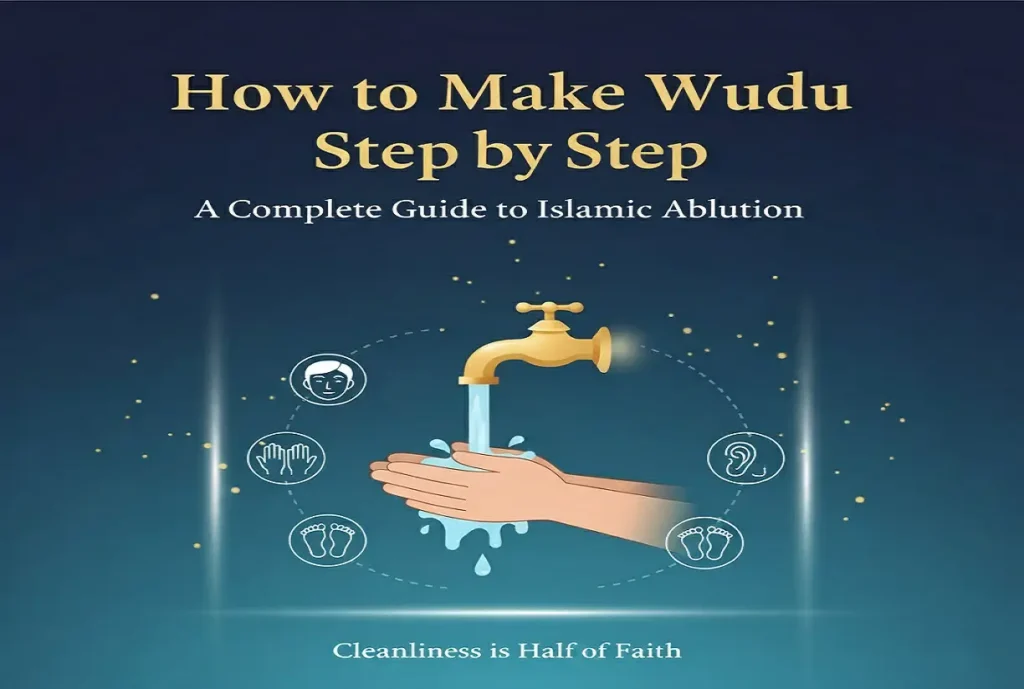
Say “Bismillah” (in the name of Allah) before beginning wudu and make niyyah (intention) to perform wudu.
1- The Islamic idea of niyyah is doing something for Allah’s benefit. In order to perform wudu (ablution) properly, you should calm your mind, center yourself, and pay close attention to what you are doing.
Niyyah should be made in the heart and should not be spoken aloud; focusing on the word “Bismillah” (in the name of Allah) is a helpful way to achieve the required centering. Say it aloud or quietly to yourself depending on how it feels for you.
2- Wash your hands. To clean your right hand, use your left hand. Repeat three times. After that, wash your left hand three times with your right hand. Make sure to wash all the way up to your wrists, including in between your fingers.
3- Bring some water to your mouth. Pour three cups of water into your mouth with your right hand. It should be rubbed into your cheeks. Do this carefully.
4- Float some water up your nose. Breathe in through your nose three times while using your right hand to cup water. Snort quickly and abruptly without putting too much water in your nose and choking yourself. If you are unable to breathe through your nose, wet your fingers and place water on the inside of your nostrils.
Use only safe water for this ritual; in some hotter regions of the world, water may contain naegleria fowleri, an amoeba that, if inhaled into the nostrils, can cause a rare but frequently fatal type of brain infection. Even tap water (typically in third-world and developing countries) may be contaminated; to prevent this illness, boil water for one minute (three minutes at higher elevations), let it cool, and then rinse your nose with it.
5- Your face should also be washed. Spreading your hands from the hairline to the chin and from your right ear to the left, wash your face three times.
6- Wash your lower arms entirely, from the tip of your fingers to your elbows, begin with your right hand, then your left hand.
If you are wearing a cast, you may wipe over it.
7- Wipe over your head. “Maseh” is the term for this. It’s beloved to make it one time from the forehead to the back of the head, and once more from the back of the head to the forehead, gently wipe the entire head with your wet hands, but it’s ok if you wipe on small part from your head.
8- Your ears are recommended to be cleaned. Clean behind your ears using your thumb from the bottom to the top. This is also carried out once.
9- Wash your two feet. Make sure the water reaches between the toes and cleans up to the ankles. To remove anything between, go through each toe with your pinky finger. You should scrub each foot three times, beginning with the right foot.
10- Recall the sequence. Wudu should be performed sequentially (Tarthib), so it’s critical to understand the steps’ hierarchy so you can correctly perform each one.
If you mess up the order, you have to start your wudu over from scratch.
11- After you have finished, say the du’as. They are: “Ash-hadu ‘an laa ‘ilaaha ‘I’ll allaah wahdahu laa shareeka lahu wa ‘ash-hadu ‘anna Muhammadan ‘abduhu wa Rasooluhu.Allaahummaj’alnee minat-tawwaabeena waj’alnee minal-mutatahhireen.Subhaanaka Allaahumma wa bihamdika, ‘ash-hadu ‘an laa ‘ilaaha ‘illaa ‘Anta, ‘Astagh firuka wa ‘atoobu ‘ilayk..”
In English: “I testify that there is no one worthy of worship besides Allah. He is all by Himself and has no partner, and I testify that Muhammad ﷺ is Allah’s servant and Rasul (Messenger) O Allah, count me (include me) among those who seek forgiveness and amongst those who stay clean O Allah, You are pure, I praise You and testify that only You are worthy of worship and I seek forgiveness from You I turn to You for repentance”
12- Before you pray, repeat nullified wudu. Natural excretions such as urination, vomiting, defecation, excessive bleeding, and gas are actions that nullify wudu. Wudu is also eliminated by deep sleep.
Salat cannot be performed after intercourse if only wudu is repeated. Another type of purification, called Ghusul, is also required.