One of the five pillars of Islam is the act of prayer (salat; plural: salah or “salawat”). All adult Muslims (those who have reached puberty) are obligated to perform the five daily prayers according to the method set by the Prophet Muhammad (PBUH), and youngsters ten and older should be firmly required to do so.
It is considered that keeping in touch with Allah is essential for a believer’s faith to grow.
Muslims believe that Allah speaks with them through the Qur’an and that salah is how we answer Allah. It’s never too early to begin learning about Muslim prayer, whether you’re interested in seeing how others do it or want to do it yourself.
Here is the step by step guide to how to get ready for prayer:-
1- Make sure your prayer location is clean and impure-free.
This applies to your entire person, attire, and prayer space. Perform wudu before beginning your prayer, you must be ritually pure. You must first conduct wudu (ablution). You must perform wudu if, after your last prayer, you have urinated, defecated, passed gas, bled excessively, passed madhy (urethral fluid), or slept off deeply.
Men are strongly advised to worship at masjids (mosques), but if you do, enter gently because other Muslims may still be praying there, and you don’t want to disturb them.
Many Muslim households have a space set out for salah. Spread a mat on the floor if you aren’t convinced the place is clean. For Islamic culture, the prayer rug is crucial.
2- If necessary, take a ghusl (full shower).
In some cases, you’ll need to perform ghusl instead of wudu to completely purify yourself by getting rid of najas (impurities) before praying. If you want to pray after engaging in sexual activity, finishing your period, experiencing postpartum bleeding, giving birth, having a wet dream, or ejaculating for sexual pleasure, you must do ghusl.
Ghusl means to cleanse your body and hair with water thoroughly. It is advised to wash three times.
Remember that before doing wudu or ghusl, you must remove everything that prevents water from touching the required parts of your body, including nail polish, jewellery, and waterproof mascara. Your prayer will only be legitimate and accepted if you make wudu or ghusl as instructed by Islam.
3- If necessary, carry out Tayammum (dry purification).
A Muslim may choose to perform tayammum instead of wudu or ghusl if they cannot use water. To execute tayammum in this ritual, clean dirt, soil, or an unworn natural rock must be used.
4- The Qibla should be your direction.
All Muslims should face this way when turning to face the Holy Ka’bah during prayer. The holy Mosque in Mecca is the most venerated place of worship for Muslims worldwide. Muslims must face the Ka’bah five times daily when they offer their prayers.
You can offer Salat without facing the Ka’bah if you are on a ship or in an airplane and worry that the time for prayer will end before you arrive somewhere where you can determine the direction of the Ka’bah. It is Mustahab (recommended) that one face the Ka’bah at least during the takbeer of ihram (saying “Allahu Akbar” at the beginning of Salat).
5- Be sure to pray at the right time.
Depending on one’s location and the season, the five prayers of each day are said at precise times. Each one has a short window of time during which it can be carried out based on the sun’s ebb and flow. A fard salah takes roughly 5 to 10 minutes from beginning to end, although it should always be timely.
As a sign of loving Allah try to offer your prayers at the beginning of the designated hour.
The five prayers are Isha, Maghrib, Asr, Fajr, and Zuhr. They occur at many times of the day, including sunrise, midday, sunset, and at night. They are not at the same time every day because the sun, whose path fluctuates with the seasons, sets the time for them.
The number of rak’ah (units) in each of the five salah is as follows: Required prayers – Two units of the Fajr prayer (Rak’ah) – Four units of Dhuhr prayer (Rak’ah) – Four units of Asr prayer (Rak’ah) – Three units of the Maghrib prayer (Rak’ah) – Four units of Isha prayer (Rak’ah).
6- Learn to offer prayers in Arabic.
The Qur’an was revealed in the Arabic language; thus, Salah must also be performed in that language. Additionally, it enables Muslims outside nations that speak Arabic to repeat the prayers and comprehend what is being said. The confusion of translating words into other languages is avoided by speaking all prayers in the same language. Use internet resources, such as Rosetta stone, Salaam Arabic, Madinah Arabic, or Youtube, to practice pronouncing the words for the required prayers.
Attend a college nearby and take an Arabic course. With an Arabic speaker, learn how to pronounce the words correctly since the prayer may only be accepted if they are.
During the prayer, both men and women must wear clothing that covers their skin. Men must have the area between their navel and legs covered, while women must cover everything except their faces and hands. During the movements of prayer, the material must cover the body. Therefore, before beginning her prayer, a lady would need to ensure that her clothes are correctly tucked in or put on more clothing if, for instance, bending caused a piece of material to slip and reveal skin on her neck.
Heavy and Light Letters in Arabic (Tafkhīm and Tarqīq): A Complete Beginner-to-Advanced Guide Introduction: Why Heavy and Light Letters Matter When a...
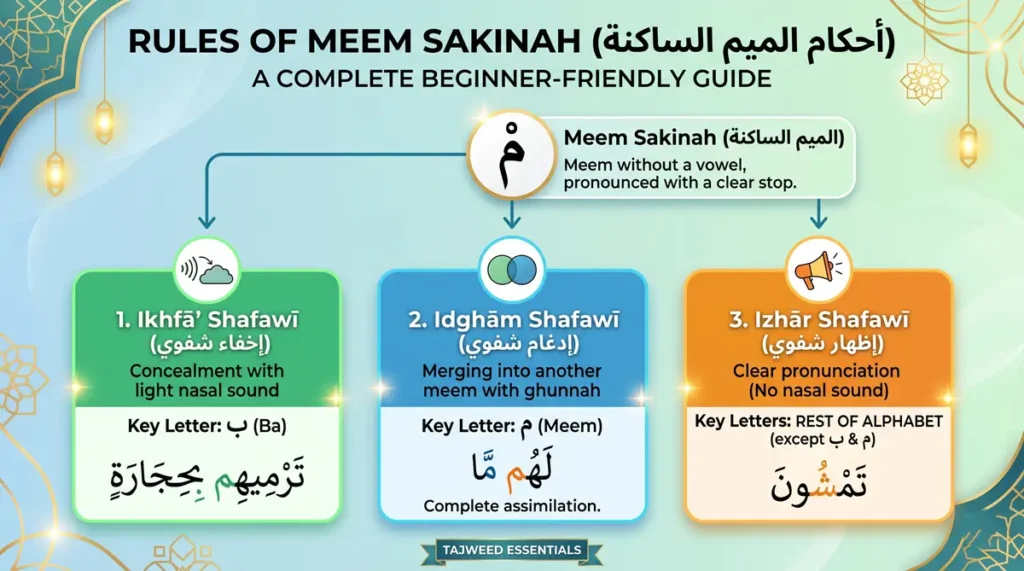
Rules of Meem Sakinah (أحكام الميم الساكنة): A Complete Beginner-Friendly Guide Meem Sakinah (الميم الساكنة) refers to the Arabic letter م (meem) that...