“What deeds are the best?” a man enquired of the Prophet (PBUH ). The Prophet stated: “(1) To perform the (daily compulsory) prayers at their (early) stated fixed times, (2) To be good and dutiful to one’s own parents, (3) And To Participate In Jihad In Allah’s Cause.”
The previous hadith stated that offering prayers on time, in the correct manner, is one of the best things one can perform for Allah. A Muslim who prays at the start of the prayer period demonstrates how highly they regard and appreciate it.
2. Take care of parents
Allah explicitly commanded us to be good and kind to our parents in several passages in the Quran, including the one below from Surah Luqman:
“And We have enjoined upon man [care] for his parents. His mother carried him, [increasing her] in weakness upon weakness, and his weaning is in two years. Be grateful to Me and to your parents; to Me is the [final] destination.”
As a result, treating parents well is seen as one of the most significant and virtuous activities. As for praising Allah Almighty, who connected parental benevolence with His unity, appreciating parents is the same as doing so.
3. Persistence in performing good activities
Muslims must persist in performing good works and not give up. According to ‘A’isha, God’s Messenger said,
“The acts most pleasing to God are those which are done most continuously, even if they amount to little.” (Bukhari and Muslim.)
4. Study the Quran to become more educated about Allah's words
Learning the Qur’an entails memorization, recital, comprehension, and moral assimilation. … order for the Muslim to stand in a position of honor before Allah both now and in the hereafter. If attending an Islamic center is not an option, you can still learn the Quran online from a knowledgeable teacher.
5. To clear the route of dangerous things
The advantages of cleaning a corridor of dangerous things are amazing! According to Abu Hurayra, the Prophet of Allah, peace be upon him, said:
‘While a man was going on a way, he saw a thorny branch and removed it from the way and Allah became pleased by his action and forgave him for that.’ [Al-Bukhari; the Book of the Adhaan]
This is to be held accountable to the notion and desire to do good; preventing harm is a way for society as a whole to cooperate.
6. Appealing to Islam
Allah likes the most to spread the Islamic message. Allah Almighty said in His holy book: And who is better in speech than one who invites to Allah and does righteousness and says, “Indeed, I am of the Muslims.”
The individual making the call to Allah must be a seeker of knowledge, knowledgeable about what they are calling for, full of patience and wisdom, eager to put up the effort, continually researching, connected to scholars, and blessed with the best manners.
7. Help people
The Prophet, peace and blessings be upon him, is claimed to have stated:
“The most beloved people to Allah are those who are most beneficial to people. The most beloved deed to Allah is to make a Muslim happy, to remove one of his troubles, to forgive his debt, or to feed his hunger. That I walk with a brother regarding a need is more beloved to me than that I seclude myself in this mosque in Medina for a month. Whoever swallows his anger, then Allah will conceal his faults. Whoever suppresses his rage, even though he could fulfill his anger if he wished, then Allah will secure his heart on the Day of Resurrection”.
8. The act of remembering Allah (Zikr)
We are urged to recall Allah (Zikr) in the Quran by many passages, for instance:
“And it is He who has made the night and the day in succession for whoever desires to remember or desires gratitude.
“the men who remember Allah often and the women who do so – for them Allah has prepared forgiveness and a great reward.”
One of the factors leading to sins being forgiven and reaching high status is remembering Allah.
9. Solid values
Allah is pleased with those of His devoted followers who uphold the strict Islamic moral laws established by the Shari’ah. According to the Prophet, peace be upon him.
‘The best among you are those with the best manners and character’.
The advice to avoid wrongdoing in words and deeds is included beside the finest principles, together with humility, patience, and helping others.
Imitating the Prophet, peace be upon him, in that. Allah Ta’ala says:
“Indeed, in the Messenger of Allah you have an excellent example for whoever has hope in Allah and the Last Day, and remembers Allah often.” (Surah Al-Ahzab Ayah 21)
10. Remembering Allah during the night and fasting
Fasting is one of the primary rituals in Islam. The servant’s relationship with their Lord is strengthened by these two deeds because Allah loves them both. The soul also receives instruction on how to protect against sin, perceive Allah’s presence, avoid being drawn to earthly pleasures, and find contentment in this life and the next.
Narrated `Abdullah bin `Amr bin Al-`As:
Allah’s Messenger (ﷺ) told me, “The most beloved prayer to Allah is that of David and the most beloved fasts to Allah are those of David. He used to sleep for half of the night and then pray for one-third of the night and again sleep for its sixth part and used to fast on alternate days.”
11. Consistently giving thanks to and praising Allah
One of the characteristics of the believer who seeks God’s happiness is that they are continually thankful for the blessings that God Almighty has provided them. This is because the servant is conscious of the importance of this good conduct to Allah.
12. Adhere to the righteous
Taking after those who have already obtained Allah’s pleasure and those whom Allah mentioned and praised in His Holy Book, such as the practitioners of righteousness and faith, since it is one of the characteristics of the aspirant to obtain Allah’s Almighty pleasure.
God Almighty praised the Islamic nation for encouraging good, forbidding evil, and commanding righteousness and forbidding transgression.
“You are now the best people brought forth for (the guidance and reform of) mankind.88 You enjoin what is right, forbid what is wrong, and believe in Allah.” Al-Imran 110.
Heavy and Light Letters in Arabic (Tafkhīm and Tarqīq): A Complete Beginner-to-Advanced Guide Introduction: Why Heavy and Light Letters Matter When a...
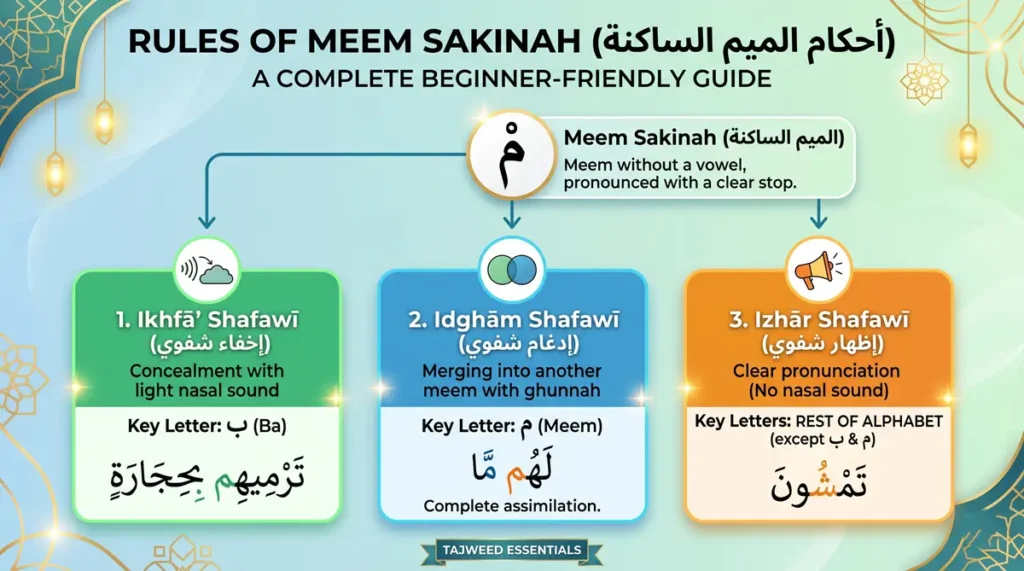
Rules of Meem Sakinah (أحكام الميم الساكنة): A Complete Beginner-Friendly Guide Meem Sakinah (الميم الساكنة) refers to the Arabic letter م (meem) that...