Time for Tahajjud and Taraweeh prayers, duas, benefits, and more
In Islam, a night prayer made by a Muslim to appease Allah is referred to as tahajjud. Tahajjud is a supplement and not one of the five daily (day and night) prayers a Muslim must offer. Both the Qur’an and the Sunnah graciously commended it and emphasized its benefits.
Tahajjud in Arabic means the practice of staying up late at night. Tahajjud is technically a recommended or voluntary prayer that a Muslim offers at night or, mainly, after sleeping, to appease Allah.
How do you pray the Taraweeh?
The Tarawih prayer, offered at night in the Ramadan month after the Isha Prayer, is performed by Muslims in groups together. Prophet Muhammad led the people in prayer three times during the Taraweeh prayer; however, on the fourth day, he stayed inside because it was a sunnah prayer, and he did not go out to join the people.
The Taraweeh prayer consists of four rak’ahs, a pause (which may include a brief Khutbah), followed by another four prayers and three rakas.
Is Tahajjud Reliant on Sleep?
It is not necessary to sleep before Tahajjud, or “the voluntary night prayer,” to get its benefit from Allah Almighty. However, according to some scholars, this night prayer is only referred to as tahajjud if preceded by sleep because the word tahajjud in its grammatical definition contains this implication.
What Is Tahajjud's Status in Islam?
Tahajjud has been established as a confirmed Sunnah that the prophet Muhammad (PBUH) used to offer. All Muslims were required to perform tahajjud at the inception of Islam. This responsibility was lowered to a recommendation to whoever wanted to make it after about a year. Al-Muzzamil, one of the first Surahs of the Quran to be revealed, contains the following:
O you who wraps himself [in clothing] (1) Arise [to pray] the night, except for a little (2) – Half of it – or subtract from it a little (3) Or add to it, and recite the Qur’an with measured recitation. Indeed, We will cast upon you a heavy word. (5) Indeed, the hours of the night are more effective for concurrence [of heart and tongue] and more suitable for words.”
Tahajjud Prayer Time is advised to be offered every night, or as frequently as a Muslim can, following ‘Ishaa’ (obligatory night prayer), up to Fajr (obligatory morning prayer).
It is best to offer it after true midnight (i.e., between twilight and dawn, not at exactly midnight) to avoid potential distractions. The best time for Muslims to perform Tahajjud is in the final third of the night after they have slept a bit.
Allah’s Messenger (PBUH) stated, according to Abu Huraira:
When it is the last third of the night, our Lord, the Blessed, the Superior, descends every night to the heaven of the world and says, ‘Is there anyone who invokes Me (demand anything from Me), that I may respond to his invocation; Is there anyone who asks Me for something that I may give (it to) him; Is there anyone who asks My forgiveness that I may forgive him?’”
[Sahih al-Bukhari]
What Advantages Does Tahajjud Offer?
There are numerous pieces of evidence supporting the advantages and rewards that Tahajjud observance brings:
1. A secret reward promised by Allah (SWT)
In the Qur’an, Allah defines those who offer nighttime prayers as follows:
“They arise from [their] beds; they supplicate their Lord in fear and aspiration, and from what We have provided them, they spend. (16) And no soul knows what has been hidden for them of comfort for eyes as reward for what they used to do.”
“Indeed, worship in the night is more impactful and suitable for recitation.”
[Quran 73:6]
These are just a few of the evidences demonstrating the prestige and benefits a Muslim receives from observing Tahajjud. There are many more.
Tahajjud prayer of the prophet in Ramadan
As told by Aisha:
With the start of the last ten days of Ramadan, the Prophet (PBUH) used to tighten his waist belt (i.e. work hard) and used to pray all the night, and used to keep his family awake for the prayers.”
[Sahih al-Bukhari]
Taraweeh and Tahajjud prayers supplications:
One of the most well-known duas (supplications) the Prophet (PBUH) uses to begin his tahajjud prayer is this one:
“O Allah, Lord of Jibraīl, Mīkaīl and Israfīl (great angels), Creator of the heavens and the Earth, Knower of the seen and the unseen. You are the arbitrator between Your servants in that which they have disputed. Guide me to the truth by Your leave, in that which they have differed, for verily You guide whom You will to a straight path.”
However, you are free to say any duaa specified in the Quran, the Sunnah, or even one that is not mentioned but that you feel is necessary or preferable during tahajjud prayer and sujud (prostration).
To sum up, tahajjud is a confirmed Sunnah practiced by Muhammad (PBUH) and his honourable companions. Muslims everywhere, at all times, and in all ages should emulate them. Muslims seek the same connection and constancy as others to find tranquility and peace. Tell us where you find peace and tranquility.
Heavy and Light Letters in Arabic (Tafkhīm and Tarqīq): A Complete Beginner-to-Advanced Guide Introduction: Why Heavy and Light Letters Matter When a...
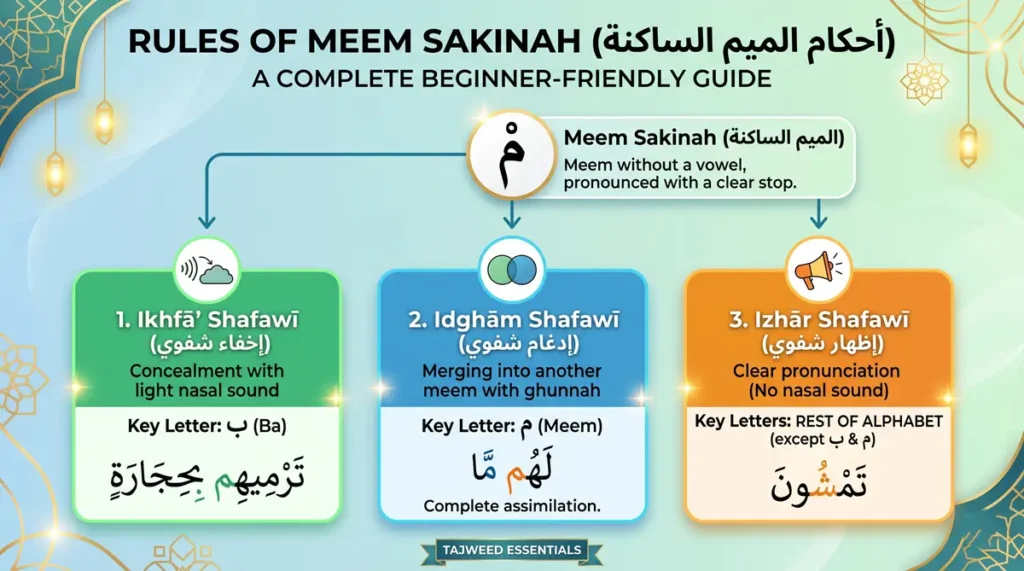
Rules of Meem Sakinah (أحكام الميم الساكنة): A Complete Beginner-Friendly Guide Meem Sakinah (الميم الساكنة) refers to the Arabic letter م (meem) that...