
If you have any questions
Don’t hesitate to reach out to us via live chat or email!
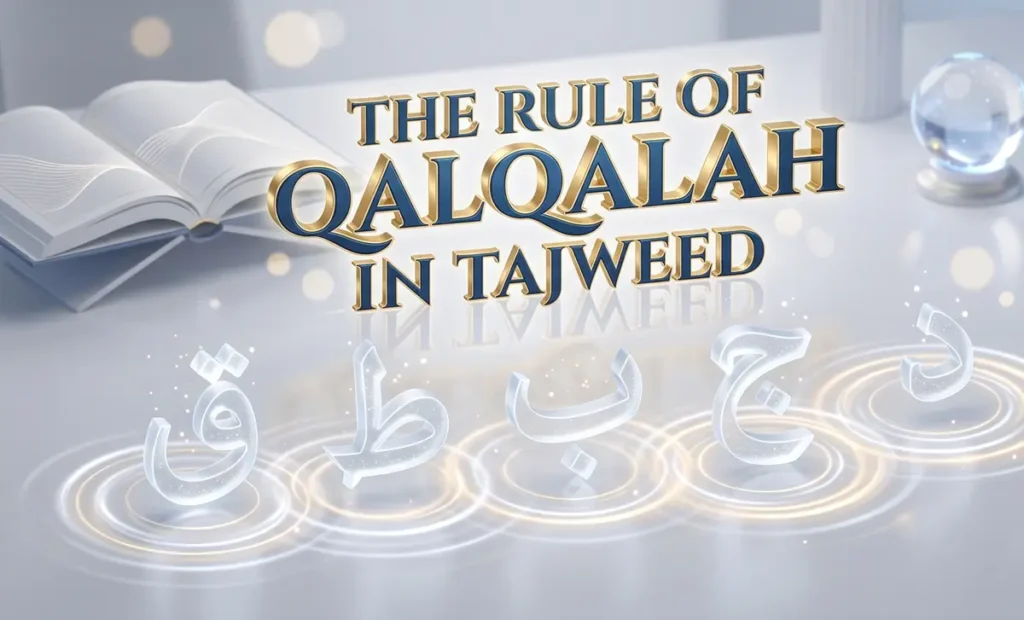
Learn the rule of Qalqalah in Tajweed with clear definitions, examples from the Qur’an, Arabic and English explanations, and practical tips for beginners. Discover the letters of Qalqalah, its types, and how to pronounce them correctly.
In This Article
ToggleQalqalah (قَلْقَلَة) is a Tajweed rule that produces a slight “echoing” or “bouncing” sound when certain letters are pronounced in a state of sukoon (no vowel).
The five letters of Qalqalah are:
ق ط ب ج د
(Qāf, Ṭā, Bā, Jīm, Dāl)
These letters are remembered with the phrase:
قطب جد (Qutb Jad)
When one of these letters has a sukoon (ْ) or appears at the end of a word during a pause, it is pronounced with a controlled, light bounce , without adding an extra vowel.
The Qur’an is not just a book to be read — it is a divine revelation to be recited. Allah ﷻ commands in the Qur’an:
وَرَتِّلِ ٱلْقُرْءَانَ تَرْتِيلًا
“And recite the Qur’an with measured recitation.”
— Surah Al-Muzzammil (73:4)
Reciting with Tajweed means giving every letter its proper right and characteristic. Tajweed preserves the original pronunciation taught by the Prophet ﷺ.
The Prophet ﷺ said:
“The one who recites the Qur’an skillfully will be with the noble and righteous scribes (angels), and the one who recites with difficulty and stammers will have two rewards.”
— Sahih al-Bukhari and Sahih Muslim
This means learning Tajweed is an act of worship. Even struggling is rewarded.
Among the most important foundational Tajweed rules for beginners is Qalqalah. It affects pronunciation clarity and prevents distortion of words. In this detailed guide, we will explore:
By the end, you will confidently understand and apply this rule in your recitation, in shā’ Allāh.
Makhraj literally means “exit point.”
In Tajweed, it refers to:
The exact place in the mouth or throat from which a letter is pronounced.
Every Arabic letter has a specific location where its sound comes from. If that location changes, the letter changes.
For example:
If you pronounce a letter from the wrong makhraj, it may turn into another letter. That is why learning makhraj is essential for correct Qur’an recitation.
In simple words:
Makhraj answers the question: “Where does this letter come from?”
Ṣifāt literally means “characteristics” or “qualities.”
In Tajweed, it refers to:
The unique sound qualities or traits of a letter when it is pronounced.
Even if two letters share a similar makhraj, their ṣifāt make them different.
For example:
These characteristics affect:
In simple words:
Ṣifāt answer the question: “How does this letter sound?”
Both are necessary to pronounce the Qur’an correctly.
Without proper makhraj, the letter changes.
Without proper ṣifāt, the beauty and precision are lost.
Linguistic Meaning
The word Qalqalah (قلقلة) in Arabic comes from the root قلقل, which means:
It refers to a vibration or bouncing motion.
Technical Meaning in Tajweed
In Tajweed terminology, Qalqalah refers to:
A slight echoing or bouncing sound heard when pronouncing one of the five Qalqalah letters in a state of sukoon.
This bounce occurs because these letters are strong, plosive sounds that stop airflow completely. When they are in sukoon, the sound cannot flow smoothly — so a natural bounce is heard.
But remember:
It is not an added vowel. It is a controlled echo.
The five letters are:
Arabic Letter | Name | English Transliteration |
ق | Qāf | Q |
ط | Ṭā | Ṭ |
ب | Bā | B |
ج | Jīm | J |
The Five Letters of Qalqalah (قطب جد)
The letters are:
ق ط ب ج د
They share two essential characteristics:
Because of Shiddah, airflow is fully stopped.
Because of Jahr, the sound continues internally.
When such a letter carries sukoon (ْ), the sound cannot flow forward — so it rebounds slightly. That rebound is Qalqalah.
Now let us analyze each letter thoroughly.
Qāf emerges from:
The deepest part of the tongue touching the soft palate (near the uvula).
It is one of the furthest letters in the mouth — almost from the throat area but technically from the tongue.
When pronouncing it correctly:

Qāf carries:
Because it is a letter of Isti‘lā’ (heavy letters), it has depth and thickness in tone.
This makes Qāf one of the strongest Qalqalah letters.
When Qāf has sukoon:
Example:
خَلَقْ
If stopping on:
خَلَقْ
The steps internally are:
The bounce must:
It must NOT sound like:
It is simply a crisp release.
Because Qāf is deep and heavy:
Among all Qalqalah letters, Qāf typically has the strongest natural bounce.
Balance is key.
Ṭā comes from:
The tip of the tongue touching the upper front teeth ridge (like ت),
but with elevation of the back of the tongue.
This dual action (front contact + back elevation) makes it heavy.
Ṭā possesses:
It is among the strongest Arabic letters.
Example:
أَحَطْتُ
If stopping:
أَحَطْ
Because Ṭā is heavy:
The release feels like a compressed pressure being gently released.
Both are heavy.
Difference:
Thus:
Bā is pronounced from:
Complete closure of both lips.
It is bilabial.
When you say “ب”:
Bā has:
Unlike Qāf and Ṭā, it is not heavy.
Example:
لَهَبٍ
Stopping:
لَهَبْ
Procedure:
Because it is light, the bounce is softer.
The echo of Bā:
It is often the easiest Qalqalah letter for beginners to detect.
Remember: Bā remains light even during Qalqalah.
Jīm comes from:
The middle of the tongue touching the middle of the hard palate.
It is a palatal letter.
The tongue rises centrally, not at the tip or back.
Jīm has:
It also carries a slight friction quality depending on dialect, but in classical recitation it remains a clear plosive.
Example:
يَجْعَلُونَ
The جْ has minor Qalqalah.
Stopping example:
وَالْفَلَقْ (though Qāf here)
If Jīm occurs at stopping, its bounce becomes stronger.
The Qalqalah of Jīm:
Dāl is pronounced from:
The tip of the tongue touching the roots of the upper front teeth.
It is similar to English “d”.
Airflow stops completely.
Dāl has:
It is one of the clearest plosive letters in Arabic.
Example:
From Surah Al-Ikhlas:
أَحَدْ
When stopping on:
أَحَدْ
The tongue:
The bounce must not turn into “du”.
Dāl’s Qalqalah:
It resembles the natural stop in English “good” — but with a controlled echo.
From strongest natural echo to lightest:
However, actual strength depends on:
Or continuing (Sughra)
Because they combine:
Other letters may have Shiddah, but not the same acoustic behavior.
These five uniquely create internal pressure that demands release.
Without Qalqalah:
The word could become unclear.
When Allah commands:
وَرَتِّلِ ٱلْقُرْءَانَ تَرْتِيلًا
“Recite the Qur’an with measured recitation.” (73:4)
He commands precision.
Every letter — even in sukoon — must be heard.
Qalqalah teaches us:
Even a stopped letter has life.
Practice these isolated stops:
Then increase difficulty:
Record yourself. Compare with a qualified Qāri’.
Qalqalah is not an added sound.
It is not decoration.
It is not exaggeration.
It is:
The natural, controlled release of a strong, voiced letter in sukoon.
When you understand the makhraj and ṣifāt of each letter in قطب جد, Qalqalah becomes effortless and balanced.
May Allah make our tongues truthful with His Book and our hearts attached to its precise recitation.
Scholars of Tajweed divide Qalqalah into two main types:
This occurs when:
Example:
يَجْعَلُونَ
The جْ has sukoon inside the word.
The bounce is present but light.
This occurs when:
Example:
From Surah Al-Ikhlas:
قُلْ هُوَ ٱللَّهُ أَحَدْ
When stopping on:
أَحَدْ
The دْ receives a stronger bounce.
Why stronger?
Because stopping places natural emphasis on the final letter.
Here is how beginners can train properly:
Step 1: Close the articulation point firmly
Do not weaken the letter.
Step 2: Do NOT add a vowel
Avoid saying:
It should remain sukoon.
Step 3: Allow a controlled bounce
Not exaggerated, not weak.
Step 4: Practice minimal pairs
Compare:
Incorrect:
أَحَدُ
Correct:
أَحَدْ (with slight echo, not “du”)
It should not sound theatrical or dramatic.
Swallowing the letter removes clarity.
Their Qalqalah must reflect their weight.
Let’s examine verses from:
Qur’an
Surah Al-Ikhlas (112)
قُلْ هُوَ ٱللَّهُ أَحَدْ
Allah, the Eternal Refuge.
Notice:
Surah Al-Falaq (113)
مِن شَرِّ مَا خَلَقْ
When stopping:
Surah Al-Masad (111)
تَبَّتْ يَدَا أَبِي لَهَبٍ
When stopping on:
Allah says:
إِنَّا نَحْنُ نَزَّلْنَا ٱلذِّكْرَ وَإِنَّا لَهُۥ لَحَـٰفِظُونَ
“Indeed, We have sent down the Reminder, and indeed We will preserve it.”
— Surah Al-Hijr (15:9)
Part of preservation is correct pronunciation.
Tajweed prevents:
Qalqalah ensures powerful letters remain clear.
Is Qalqalah obligatory?
Basic Qalqalah that preserves clarity is required. Perfecting its levels is part of improving recitation.
Does Qalqalah apply if the letter has a vowel?
No. It only applies in sukoon or when stopping.
Is Qalqalah louder or just echoed?
It is not louder — just clearer and slightly bounced.
Can beginners exaggerate while learning?
It is common initially, but correction is needed to avoid habit formation.
Learning Tajweed is not merely technical — it is an act of love for Allah’s words.
The Prophet ﷺ loved beautiful recitation. He said:
“Beautify the Qur’an with your voices.”
— Abu Dawood
When we perfect Qalqalah, we:
Qalqalah is the echoing sound produced when the letters ق ط ب ج د are pronounced with sukoon.
It exists in two types:
It ensures clarity and precision in Qur’an recitation.
Mastering Qalqalah:
Earns reward from Allah
Let us clarify this carefully and in a structured way.
Short Answer
Yes, Arabs naturally apply Qalqalah in their normal speech, but:
Qalqalah is not an invention of Tajweed. It is a natural phonetic feature of the Arabic language itself.
Although Qalqalah exists naturally in Arabic, there is a difference between:
1️⃣ Natural Speech
2️⃣ Qur’anic Recitation (with Tajweed)
Let us examine the difference.
In daily speech:
For example:
If an Arab says:
بَعْد (after)
The دْ at the end will naturally have a slight release.
But the speaker is not thinking:
“Now I will apply Qalqalah.”
It is simply how the language functions.
In recitation of the Qur’an:
Because the Qur’an must be recited exactly as revealed, Tajweed ensures:
So while Qalqalah exists naturally, Tajweed regulates it.
No.
Some beginners think:
“Is Qalqalah something added to beautify the Qur’an?”
The answer is no.
It is not decoration.
It is not musical styling.
It is not dramatic emphasis.
It is the natural acoustic result of pronouncing certain Arabic letters in sukoon.
Tajweed simply protects that natural sound from being:
This is where nuance is important.
Classical Arabic — the language of the Qur’an — preserves Qalqalah clearly.
However, in some modern dialects:
For example:
In some dialects, final “د” might sound lighter than in classical pronunciation.
But even then, the basic plosive release remains — because it is a structural feature of the letter itself.
In everyday speech:
In Qur’anic recitation:
Allah says:
وَرَتِّلِ ٱلْقُرْءَانَ تَرْتِيلًا
“And recite the Qur’an with measured recitation.” (73:4)
Measured recitation requires deliberate articulation.
Thus, Tajweed preserves what natural speech already contains — but with discipline.
Imagine an Arab saying casually:
خَلَقْتُ (I created)
The قْ will have a natural release.
Now imagine reciting from the Qur’an:
خَلَقْنَا
The Qāf must be:
The difference is not whether Qalqalah exists.
The difference is how precisely it is executed.
Some students worry:
“If Arabs already do Qalqalah naturally, why do we need to study it?”
Because:
Tajweed training ensures:
Even native Arabs formally study Tajweed to refine Qur’anic recitation.
From a phonetic perspective:
Qalqalah occurs because these letters are:
In modern phonetics, this is called a released plosive stop.
This happens in many languages.
For example in English:
There is a release sound when stopping on “p”, “k”, or “d”.
Arabic simply preserves it more clearly and systematically.
If you are new to Tajweed, take your time. Even small corrections bring immense reward.
Remember the hadith:
“The one who recites with difficulty has two rewards.”
Every effort matters.
May Allah make us among the people of the Qur’an — those who recite it properly, understand it deeply, and live by it sincerely.
Āmīn.
If you have any questions
Don’t hesitate to reach out to us via live chat or email!