Acquiring a new language is a demanding yet deeply fulfilling pursuit. As one of the most widely spoken languages globally, Arabic offers a rich tapestry of diverse dialects and cultural depth. While mastering Arabic within a single year is an ambitious objective, it remains an attainable milestone with a structured strategy and consistent dedication.
To accelerate your progress and achieve fluency within this twelve-month timeframe, you must adopt specific methodologies that maximize learning efficiency. This guide outlines the essential tips and linguistic strategies required to navigate the complexities of Arabic and reach your goal effectively.
Set clear goals
The first step to learning any language is to set clear goals. It would be best to decide what proficiency level you want to achieve in Arabic and in what timeframe. Be realistic about your goals and set achievable targets. For example, you might want to learn enough Arabic to have basic conversations with native speakers in one year. Once you have placed your goals, make sure to keep them in mind throughout your learning journey. Here are some steps you can follow to set a goal for learning Arabic in one year:
Determine your motivation: Why do you want to learn Arabic? What are your goals? Are you planning to travel to an Arabic-speaking country, study Arabic literature, or communicate with Arabic-speaking friends or business partners? Understanding your motivation will help you set a realistic goal and stay motivated throughout the learning process.
Assess your current level: You must know where you stand before setting a goal. Assess your current level of Arabic proficiency. You can take a placement test, ask a language teacher to assess you, or use an online proficiency test.
Set a realistic goal: Based on your motivation and current level, set a real goal for your Arabic learning. For example, if you’re a beginner, your goal could be to achieve basic conversational skills, while if you’re an intermediate learner, your goal could be to improve your reading and writing skills.
Break down your goal: Once you have set your overall goal, break it down into smaller, achievable goals. For example, if you aim to achieve basic conversational skills, you could break it down into learning basic vocabulary, grammar, and sentence structures.
Plan your learning: Plan how you will achieve your goals. Decide how much time you will dedicate to learning Arabic each day or week, what resources you will use, and how you will measure your progress.
Stay motivated: Learning Arabic can be challenging, so staying motivated is important throughout the process. Reward yourself for achieving your smaller goals, find a study partner, or join a language exchange program to practice your skills.
Measure your progress: Regularly measure your progress and adjust your plan accordingly. This will help you stay on track and achieve your goal within one year.
Start with the basics
When learning a new language, starting with the basics is important. Arabic has its unique alphabet, so start by learning the letters and their sounds. Once you have mastered the alphabet, move on to basic vocabulary and grammar. Learn common phrases and sentences that will help you communicate in different situations. Practice speaking, listening, reading, and writing in Arabic every day. Here are some steps to help you get started with the basics of the Arabic language:
Learn the Arabic alphabet: The Arabic language is written in a unique script, so the first step is learning the alphabet. Start by learning the shape and sound of each letter.
Learn basic greetings: Learn how to say hello, goodbye, and other basic greetings in Arabic. These phrases will help you to start conversations with native speakers.
Start with basic grammar: Learn the basics of Arabic grammar, such as word order, sentence structure, and basic verbs.
Build vocabulary: Start building your Arabic vocabulary by learning everyday words and phrases. You can start with simple, familiar words and gradually move on to more complex vocabulary.
Practice pronunciation: Practice pronouncing Arabic sounds correctly. Arabic has some sounds that are not found in English, so paying attention to your pronunciation is important.
Listen to native speakers: Listen to native speakers speaking Arabic, whether it’s through videos or in-person conversation. This will help you to become familiar with the language and its sounds.
Find a language partner or tutor.
Having someone to practice speaking with is essential when learning a new language. Find a language partner or tutor to help you practice your conversational skills. This can be a friend who speaks Arabic or a professional tutor. Look for online platforms that offer Arabic tutoring services. You can browse through tutor profiles, read reviews from other students, and compare prices.
Look for native speakers: Look for tutors who are native Arabic speakers. Native speakers are likely to better understand the language, its nuances, and its culture.
Check qualifications: Check the tutor’s qualifications and experience. An excellent Arabic tutor should have relevant certifications, experience teaching Arabic, and a strong command of the language.
Ask for a trial lesson: Ask for a trial lesson with the tutor to see if they are a good fit for you. During the trial lesson, you can assess their teaching style, language knowledge, and ability to cater to your needs.
Consider your schedule: Consider your schedule when choosing a tutor. Look for a tutor who can accommodate your schedule and provide flexible lesson times.
Look for a tutor with relevant teaching materials: Use appropriate teaching materials such as textbooks, audio and video resources, and other learning materials to help you learn Arabic more effectively.
Invest in quality resources.
Invest in high-quality textbooks, grammar books, and other resources. These resources should be comprehensive, organized, and easy to follow.
Practice regularly
Regular practice is essential for learning a new language. Practice speaking, listening, reading, and writing Arabic as often as possible. You can use language-learning apps, watch Arabic movies or TV shows, read Arabic news articles or books, and attend language exchange events to practice.
Join a language exchange program
Join a language exchange program to practice speaking with native Arabic speakers. This will help you improve your speaking and listening skills and learn more about the language and culture.
Immerse yourself in the language
Immerse yourself in the language as much as possible. This means surrounding yourself with Arabic media, culture, and people. This will help you develop a more natural and intuitive language understanding.
Track your progress
Keep track of your progress and celebrate your achievements along the way. This will help you stay motivated and see how far you have come.
Conclusion
Achieving Arabic proficiency within a single year is an attainable milestone if you adhere to a structured framework and maintain unwavering commitment. While mastering a new language demands consistent effort and disciplined practice, the journey is a transformative experience that unlocks global opportunities and broadens your cultural horizons.
Heavy and Light Letters in Arabic (Tafkhīm and Tarqīq): A Complete Beginner-to-Advanced Guide Introduction: Why Heavy and Light Letters Matter When a...
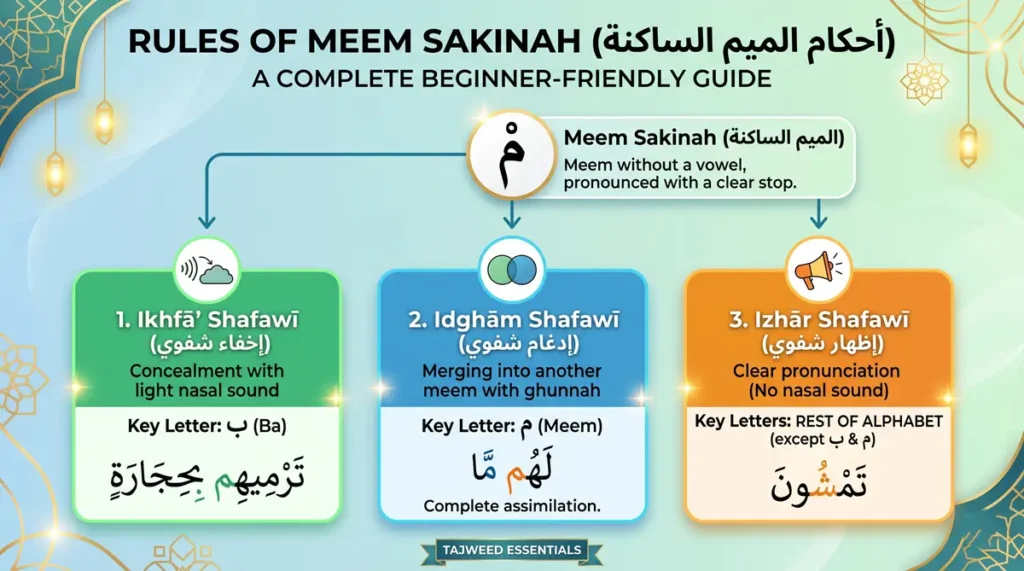
Rules of Meem Sakinah (أحكام الميم الساكنة): A Complete Beginner-Friendly Guide Meem Sakinah (الميم الساكنة) refers to the Arabic letter م (meem) that...