Ayat Academy

Rules of Meem Sakinah (أحكام الميم الساكنة): A Complete Beginner-Friendly Guide

Rules of Meem Sakinah

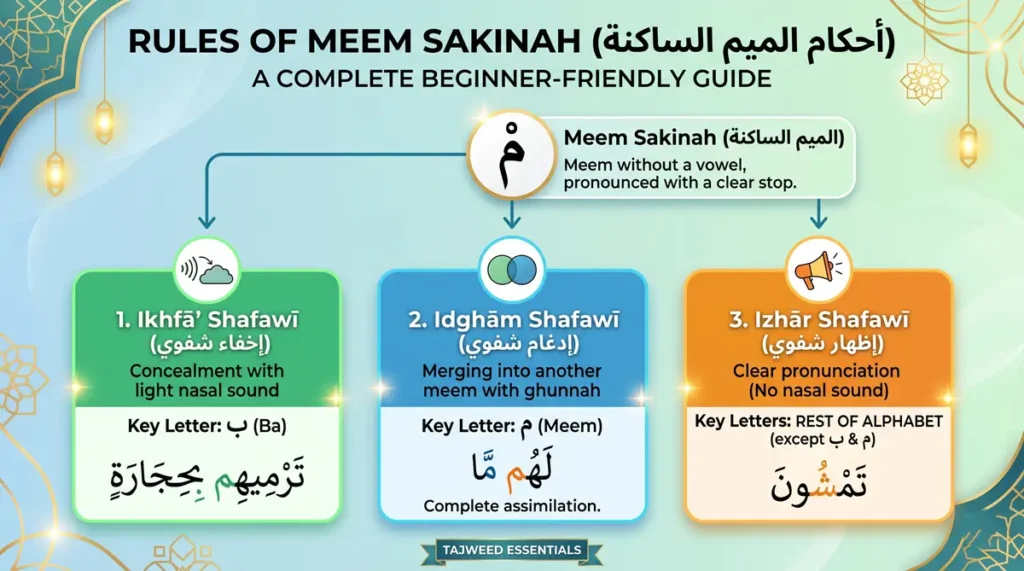
Meem Sakinah (الميم الساكنة) refers to the Arabic letter م (meem) that carries a sukūn (ْ) — meaning it has no vowel and is pronounced with a clear stopping sound.

The rules of Meem Sakinah explain how this “meem” should be pronounced depending on the letter that comes after it.

There are three main rules:

  1. Ikhfā’ Shafawī (إخفاء شفوي) – Concealment with light nasal sound
  2. Idghām Shafawī (إدغام شفوي) – Merging into another meem with ghunnah

Izhār Shafawī (إظهار شفوي) – Clear pronunciation

In This Article

Introduction: Why Meem Sakinah Matters in Tajwīd

Learning the rules of Meem Sakinah is an essential part of mastering Tajwīd (the science of proper Qur’an recitation). Tajwīd ensures that the words of the Qur’an are recited exactly as they were revealed to the Prophet Muhammad ﷺ.

For beginners, Meem Sakinah is one of the first applied rules you’ll encounter because:

  • It appears very frequently in the Qur’an
  • It affects clarity of pronunciation
  • It helps you develop proper articulation and rhythm
  • It trains your control of ghunnah (nasal sound)

Without understanding these rules, a reciter may unintentionally:

  • Change meanings
  • Distort pronunciation
  • Lose the beauty of Qur’anic recitation

This article will walk you step-by-step, from the basics to deeper understanding, using clear explanations and examples.

What is Meem Sakinah?

Linguistic Meaning

  • Meem (م): A letter from the Arabic alphabet
  • Sakinah (ساكنة): Meaning “still” or “without movement”

So Meem Sakinah literally means:

A “meem” that is in a resting state (no vowel)

Technical Definition in Tajwīd

A Meem Sakinah is:

The letter “م” with a sukūn (ْ), occurring in the middle or end of a word, followed by another letter.

Examples:

  • لَكُمْ
  • عَلَيْهِمْ
  • هُمْ فِيهَا

In each case, the meem is silent (has sukūn), and what comes after it determines how it is pronounced.

The Three Rules of Meem Sakinah

The rules depend entirely on the letter that comes after the meem.

Rule

When It Happens

Number of Letters

Ikhfā’ Shafawī

Before ب

1

Idghām Shafawī

Before م

1

Izhār Shafawī

Before all other letters

26

Let’s explore each rule in detail.

1. Ikhfā’ Shafawī (إخفاء شفوي)

Ikhfā’ Shafawī means:

To partially hide the sound of the meem while applying a nasal sound (ghunnah)

When Does It Occur?

It occurs when:

A Meem Sakinah is followed by the letter ب (baa)

Key Characteristics

  • The meem sound is not fully pronounced
  • It is also not merged
  • It is hidden slightly
  • A ghunnah (nasal sound) of about 2 counts is applied
  • Lips remain close but not fully pressed

Example from the Qur’an

  • تَرْمِيهِم بِحِجَارَةٍ

Here:

  • “مْ” is followed by “ب”
  • So we apply Ikhfā’ Shafawī

How to Pronounce It

Instead of saying a clear “m”, you:

  • Hold a nasal sound
  • Slightly prepare for the “b”
  • Let the sound flow smoothly

Common Mistakes

  • ❌ Fully pronouncing the meem (this turns it into Izhār)
  • ❌ Merging completely (this becomes Idghām)
  • ❌ Skipping the ghunnah

Practical Tip

Imagine you are:

  • Balancing between hiding and pronouncing

Not too clear, not too merged.

2. Idghām Shafawī (إدغام شفوي)

Idghām Shafawī means:

To merge the Meem Sakinah into another meem with a full nasal sound (ghunnah)

When Does It Occur?

It happens when:

A Meem Sakinah is followed by another م (meem)

Key Characteristics

  • The two meems are merged into one
  • A strong ghunnah (2 counts) is applied
  • Lips are fully closed

Example from the Qur’an

  • لَهُم مَّا

Here:

  • Meem Sakinah + Meem
  • So we apply Idghām Shafawī

How to Pronounce It

Instead of saying:

  • “hum ma”

You say:

  • “humma” (with a prolonged nasal sound)

Important Note

This is also called:

Idghām with Ghunnah (إدغام بغنة)

Common Mistakes

  • ❌ Not merging properly
  • ❌ Making it too short (losing ghunnah)
  • ❌ Overstretching beyond 2 counts

Practical Tip

Think of it as:

  • Two meems becoming one strong meem

3. Izhār Shafawī (إظهار شفوي)

Izhār Shafawī means:

To pronounce the Meem Sakinah clearly without any merging or hiding

When Does It Occur?

It occurs when:

A Meem Sakinah is followed by any letter except ب and م

That means 26 letters

Key Characteristics

  • Meem is pronounced clearly
  • No ghunnah beyond its natural sound
  • No merging or concealment

Example from the Qur’an

  • أَنْعَمْتَ

Here:

  • Meem is followed by “ت”
  • So we apply Izhār Shafawī

How to Pronounce It

You:

  • Fully pronounce the “m”
  • Then clearly move to the next letter

Special Attention Letters

Be careful when the next letter is:

  • ف (faa)
  • و (waw)

Because:

  • They come from similar lip areas
  • Students often accidentally apply Ikhfā’

Common Mistakes

  • ❌ Adding ghunnah unnecessarily
  • ❌ Hiding the meem
  • ❌ Merging by mistake

Practical Tip

Keep it simple:

Just pronounce the “m” clearly and move on.

Comparison of the Three Rules

Rule

Letter After Meem

Action

Ghunnah

Ikhfā’ Shafawī

ب

Hide

Yes

Idghām Shafawī

م

Merge

Yes

Izhār Shafawī

Others

Clear

No

Understanding Ghunnah in Meem Sakinah

What is Ghunnah

What is Ghunnah?

Ghunnah (غنة) is:

A nasal sound that comes from the nose, not the mouth

It is essential in:

  • Ikhfā’ Shafawī
  • Idghām Shafawī

Duration

  • Typically 2 counts (حركتان)

How to Practice

Try this:

  1. Close your mouth
  2. Hum “mmm”
  3. Feel vibration in your nose

That is ghunnah.

Articulation Point (Makharij) of Meem

Understanding where the sound comes from helps improve accuracy.

Meem Sound Origin

  • Comes from the lips (الشفتين)
  • Both lips must touch

Why This Matters

  • Helps distinguish between:
    • Meem (م)
    • Baa (ب)
    • Waw (و)

Step-by-Step Method to Identify the Rule

When you see a Meem Sakinah:

Step 1: Identify the Meem with Sukūn

Look for:

  • مْ

Step 2: Look at the Next Letter

Ask:

  • What letter comes after?

Step 3: Apply the Rule

  • If ب → Ikhfā’
  • If م → Idghām
  • Otherwise → Izhār

Practical Examples from the Qur’an

Ikhfā’ Shafawī

  • هُمْ بِهِ
  • عَلَيْهِمْ بِمَا

Idghām Shafawī

  • كُمْ مِّن
  • لَهُم مَّا

Izhār Shafawī

  • عَلَيْهِمْ صَلَوَاتٌ
  • أَمْ خَلَقُوا

Common Mistakes Beginners Make

  1. Confusing Ikhfā’ and Idghām
  • Ikhfā’ = partial concealment
  • Idghām = full merging
  1. Ignoring Ghunnah

Many beginners:

  • Skip nasal sound entirely
  1. Overdoing Ghunnah
  • Making it too long or exaggerated
  1. Misidentifying Letters
  • Especially confusing:
    • ب
    • م
    • و
    • ف

Tips to Master Meem Sakinah

  1. Listen to Skilled Reciters

Choose well-known Qur’an reciters and:

  • Focus on how they handle “meem”
  1. Practice Slowly

Do not rush:

  • Accuracy first
  • Speed later
  1. Use Repetition

Repeat the same verses:

  • Until rules become natural
  1. Record Yourself
  • Compare your recitation
  1. Learn with a Teacher

A qualified teacher can:

  • Correct subtle mistakes
  • Improve your Tajwīd quickly

Spiritual Reflection: Why Precision in Recitation Matters

The Qur’an is not just a book—it is:

The literal word of Allah, preserved in both meaning and sound.

Allah says:

وَرَتِّلِ الْقُرْآنَ تَرْتِيلًا
“And recite the Qur’an with measured recitation.”
(Surah Al-Muzzammil 73:4)

Tajwīd—including Meem Sakinah—is part of fulfilling this command.

FAQ Section

What are the rules of Meem Sakinah?

They are three:

  • Ikhfā’ Shafawī
  • Idghām Shafawī
  • Izhār Shafawī

How many letters are in Meem Sakinah rules?

  • 1 letter for Ikhfā’ (ب)
  • 1 letter for Idghām (م)
  • 26 letters for Izhār

What is the difference between Ikhfā’ and Idghām?

  • Ikhfā’ = concealment with ghunnah
  • Idghām = merging with ghunnah

Is ghunnah required in all rules?

  • Yes in Ikhfā’ and Idghām
  • No in Izhār

Why is it called “Shafawī”?

Because:

  • It relates to the lips (شفاه)

Rules of Meem Sakinah from Tuḥfat al-Aṭfāl (تحفة الأطفال)

One of the most beautiful and time-tested ways to learn Tajwīd is through the classical poem:

Tuḥfat al-Aṭfāl

Written by the scholar:

Sulayman al-Jamzuri

This poem is widely memorized by students of Qur’an around the world because it:

  • Summarizes Tajwīd rules in an easy poetic form
  • Is beginner-friendly
  • Helps with memorization and recall
  • Connects the student to a long scholarly tradition

In this article, we will explain the rules of Meem Sakinah exactly as presented in Tuḥfat al-Aṭfāl, while making them easy to understand for beginners.

The Original Verses on Meem Sakinah

 وَالمِيمُ إِنْ تَسْكُنْ تَجِى قَبْلَ الْهَجَا
لَا أَلِفٍ لَيِّنَةٍ لِذِي الْحِجَا

أَحْكَامُهَا ثَلَاثَةٌ لِمَنْ ضَبَطْ
إِخْفَاءٌ ادْغَامٌ وَإِظْهَارٌ فَقَطْ

فَالأَوَّلُ الإِخْفَاءُ عِنْدَ الْبَاءِ
وَسَمِّهِ الشَّفَوِيَّ لِلْقُرَّاءِ

وَالثَّانِ إِدْغَامٌ بِمِثْلِهَا أَتَى
وَسَمِّ إِدْغَامًا صَغِيرًا يَا فَتَى

وَالثَّالِثُ الإِظْهَارُ فِي الْبَقِيَّهْ
مِنْ أَحْرُفٍ وَاجِبَةٍ لَهَا شَفِيَّهْ

Line-by-Line Explanation (Beginner Friendly)

  1. Definition of Meem Sakinah

وَالمِيمُ إِنْ تَسْكُنْ تَجِى قَبْلَ الْهَجَا

Meaning:

“When the meem is sakin (has sukoon) and comes before the letters…”

Explanation:

This line defines Meem Sakinah:

A meem (م) with sukoon (ْ) that appears before another letter

لَا أَلِفٍ لَيِّنَةٍ لِذِي الْحِجَا

Meaning:

“Not followed by a soft alif (for the intelligent one to understand)”

Explanation:

This simply clarifies:

  • The rule applies when meem is followed by actual letters, not a long vowel (like alif madd)


  1. The Three Rules

أَحْكَامُهَا ثَلَاثَةٌ لِمَنْ ضَبَطْ

Meaning:

“Its rules are three for the one who masters it”

Explanation:

The poet summarizes:

There are exactly three rules for Meem Sakinah

إِخْفَاءٌ ادْغَامٌ وَإِظْهَارٌ فَقَطْ

Meaning:

“They are: Ikhfā’, Idghām, and Izhār only”

Explanation:

These are the three core rules:

  1. Ikhfā’ (concealment)
  2. Idghām (merging)
  3. Izhār (clear pronunciation)


  1. Ikhfā’ Shafawī in the Poem

فَالأَوَّلُ الإِخْفَاءُ عِنْدَ الْبَاءِ

Meaning:

“The first is Ikhfā’ when it comes before the letter Baa (ب)”

Explanation:

This line teaches:

If Meem Sakinah is followed by ب, apply Ikhfā’

وَسَمِّهِ الشَّفَوِيَّ لِلْقُرَّاءِ

Meaning:

“And call it ‘Shafawī’ (labial) according to the reciters”

Explanation:

  • “Shafawī” comes from lips (شفاه)
  • Because both meem and baa are pronounced using the lips

Summary of Ikhfā’ from the Poem

  • Happens before: ب
  • Action: Hide the meem slightly
  • Add: Ghunnah (nasal sound)


  1. Idghām Shafawī in the Poem

وَالثَّانِ إِدْغَامٌ بِمِثْلِهَا أَتَى

Meaning:

“The second is Idghām when it comes with its similar letter”

Explanation:

“Similar letter” refers to:

  • Another meem (م)

So:

Meem Sakinah + Meem = Idghām

وَسَمِّ إِدْغَامًا صَغِيرًا يَا فَتَى

Meaning:

“And call it small Idghām, O young student”

Explanation:

This introduces a technical term:

  • Idghām Ṣaghīr (small merging)
    Because:
  • The first letter is sakin
  • The second is moving

Summary of Idghām from the Poem

  • Happens before: م
  • Action: Merge the two meems
  • Add: Full ghunnah


  1. Izhār Shafawī in the Poem

وَالثَّالِثُ الإِظْهَارُ فِي الْبَقِيَّهْ

Meaning:

“The third is Izhār in the remaining letters”

Explanation:

This means:

For all other letters, use Izhār

مِنْ أَحْرُفٍ وَاجِبَةٍ لَهَا شَفِيَّهْ

Meaning:

“From the remaining letters, and it is required to pronounce it clearly (from the lips)”

Explanation:

  • The meem must be pronounced clearly
  • Without merging or hiding

Summary of Izhār from the Poem

  • Happens before: all letters except ب and م
  • Action: Clear pronunciation

No ghunnah (extra nasalization)

Why the Author Structured It This Way?

The brilliance of Tuḥfat al-Aṭfāl lies in its simplicity:

  1. Definition
  2. Number of rules
  3. Each rule explained in order

This makes it:

  • Easy to memorize
  • Easy to apply
  • Easy to teach

Deeper Understanding from the Poem

Why Only One Letter for Ikhfā’?

Because:

  • Meem (م) and Baa (ب) share the same articulation point (lips)
  • This similarity causes partial concealment

Why Idghām Happens with Meem Only

Because:

  • They are identical letters
  • So merging is natural and smooth

Why Izhār for the Rest

Because:

  • The other letters are different enough
  • No need to merge or hide

Connecting Poetry to Practice

When reciting the Qur’an:

Step 1: Spot Meem Sakinah

Step 2: Look at the next letter

Step 3: Recall the poem

  • “عند الباء” → Ikhfā’
  • “بمثلها” → Idghām
  • “في البقية” → Izhār

Practical Examples Matching the Poem

Ikhfā’ (عند الباء)

  • هُمْ بِهِ
  • تَرْمِيهِم بِحِجَارَةٍ

Idghām (بمثلها)

  • لَهُم مَّا
  • كُمْ مِّن

Izhār (في البقية)

  • عَلَيْهِمْ صَلَوَاتٌ
  • أَمْ خَلَقُوا

Common Mistakes When Studying the Poem

  1. Memorizing Without Understanding

Many students:

  • Memorize the poem
  • But cannot apply it


  1. Ignoring the Meaning of “Shafawī”

Understanding that it relates to:

  • Lips helps improve pronunciation


  1. Confusing Idghām Types
  • This is specifically Idghām Shafawī
  • Not the same as Noon Sakinah rules

Spiritual Reflection

Studying Tajwīd through classical works like Tuḥfat al-Aṭfāl connects you to:

  • Generations of scholars
  • The preservation of Qur’an recitation

It transforms recitation from:

  • A habit → into an act of precision and worship

Final Summary (From the Poem Itself)

The entire concept can be reduced to:

  • Before ب → Ikhfā’
  • Before م → Idghām
  • Everything else → Izhār

Exactly as summarized in the poem.

Closing Advice

If you are memorizing Tuḥfat al-Aṭfāl:

  • Don’t rush
  • Recite with a teacher
  • Apply each rule practically

Because Tajwīd is not just knowledge—it is:

A skill perfected through recitation

Comparison Between Noon Sakinah and Meem Sakinah Rules (أحكام النون الساكنة والميم الساكنة)

Quick Direct Answer (For Fast Understanding)

  • Noon Sakinah (نْ) has 4 rules: Izhār, Idghām, Iqlāb, Ikhfā’
  • Meem Sakinah (مْ) has 3 rules: Izhār, Idghām, Ikhfā’

👉 The key difference:

  • Noon Sakinah has more variation and letters
  • Meem Sakinah is simpler and more limited

Introduction: Why This Comparison Matters

For students of Tajwīd, one of the most common areas of confusion is:

“What is the difference between Noon Sakinah and Meem Sakinah rules?”

They appear similar because:

  • Both involve letters with sukoon
  • Both depend on the next letter
  • Both include Idghām, Ikhfā’, and Izhār

However, they are fundamentally different in:

  • Number of rules
  • Letters involved
  • Pronunciation complexity
  • Conceptual depth

Understanding this comparison will:

  • Remove confusion
  • Strengthen your Tajwīd foundation
  • Help you recite with confidence

What is Noon Sakinah?

Noon Sakinah (النون الساكنة) is:

The letter ن (noon) with a sukoon (ْ), occurring in the middle or end of a word

It also includes:

Tanween (ً ٍ ٌ) because it produces a hidden noon sound.

What is Meem Sakinah?

Meem Sakinah (الميم الساكنة) is:

The letter م (meem) with a sukoon (ْ), followed by another letter

Overview Table: Core Differences

Feature

Noon Sakinah

Meem Sakinah

Letter

ن

م

Rules

4

3

Includes Tanween?

Yes

No

Has Iqlāb?

Yes

No

Complexity

Higher

Simpler

Main Focus

Tongue + nasal

Lips + nasal

The Rules of Noon Sakinah

  1. Izhār (إظهار)
  • Clear pronunciation
  • Letters: ء هـ ع ح غ خ (6 letters)
  1. Idghām (إدغام)
  • Merge into next letter
  • Letters: ي ر م ل و ن (6 letters)

Types:

  • With ghunnah: ي ن م و
  • Without ghunnah: ر ل
  1. Iqlāb (إقلاب)
  • Noon changes into meem sound
  • Letter: ب
  1. Ikhfā’ (إخفاء)
  • Hidden sound with ghunnah

Letters: 15 letters

The Rules of Meem Sakinah

  1. Izhār Shafawī
  • Clear meem
  • Before: 26 letters
  1. Idghām Shafawī
  • Merge meem into meem
  • Before: م
  1. Ikhfā’ Shafawī
  • Hide meem with ghunnah
  • Before: ب

Deep Comparison of Each Rule

  1. Izhār: Noon vs Meem

Noon Sakinah

  • Happens with 6 throat letters
  • Strong clarity due to distance in articulation

Meem Sakinah

  • Happens with 26 letters
  • Default rule

Key Difference

  • Noon Izhār = specific letters
  • Meem Izhār = almost all letters
  1. Idghām: Noon vs Meem

Noon Sakinah

  • Happens with 6 letters (يرملون)
  • Two types:
    • With ghunnah
    • Without ghunnah

Meem Sakinah

  • Happens with 1 letter only (م)
  • Always with ghunnah

Key Difference

  • Noon Idghām = complex and varied
  • Meem Idghām = simple and consistent
  1. Ikhfā’: Noon vs Meem

Noon Sakinah

  • Happens with 15 letters
  • Wide range of sounds

Meem Sakinah

  • Happens with 1 letter (ب)

Key Difference

  • Noon Ikhfā’ = broad and nuanced
  • Meem Ikhfā’ = very specific
  1. Iqlāb: Unique to Noon

Noon Sakinah Only

  • Noon becomes meem sound before ب

Meem Sakinah

  • ❌ No Iqlāb exists

Key Insight

This is one of the biggest differences:

Noon can transform into another letter, Meem cannot

Articulation (Makharij) Comparison

Noon

  • Comes from:
    • Tip of the tongue + upper gums
  • More complex articulation

Meem

  • Comes from:
    • Lips
  • Easier and more physical

Impact on Rules

  • Noon rules are more varied
  • Meem rules are more straightforward

Ghunnah Comparison

Noon Sakinah

  • Present in:
    • Idghām (some types)
    • Ikhfā’
    • Iqlāb

Meem Sakinah

  • Present in:
    • Idghām
    • Ikhfā’

Key Difference

  • Noon ghunnah = more variable
  • Meem ghunnah = more consistent

Conceptual Comparison (From Advanced Tajwīd)

Concept

Noon Sakinah

Meem Sakinah

Identity

Idghām

Idghām

Similarity

Ikhfā’

Ikhfā’

Difference

Izhār

Izhār

Transformation

Iqlāb

None

Why Noon Sakinah is More Complex

  1. More Letters
  • 28 Arabic letters distributed across rules
  1. More Rule Types
  • Includes Iqlāb
  1. More Exceptions
  • Idghām with/without ghunnah
  1. Includes Tanween
  • Doubles the application cases

Why Meem Sakinah is Easier

  1. Only 3 Rules
  2. Only 2 Special Letters (ب، م)
  3. Mostly Default Izhār
  4. No transformation like Iqlāb

Common Student Confusions

1. Mixing Ikhfā’ and Iqlāb

  • Noon before ب = Iqlāb
  • Meem before ب = Ikhfā’

2. Applying Noon Rules to Meem

  • Incorrect assumption:
    • “Same rules apply” ❌

3. Forgetting Tanween

Only applies to Noon rules

Practical Examples Side-by-Side

Before ب

  • Noon:
    • مِن بَعْدِ → Iqlāb
  • Meem:
    • هُمْ بِهِ → Ikhfā’

Before م

  • Noon:
    • مِن مَّالٍ → Idghām
  • Meem:
    • لَهُم مَّا → Idghām

Before other letters

  • Noon: depends
  • Meem: always Izhār

Memory Trick (Very Helpful)

Noon Sakinah

“4 rules, many letters, more complexity”

Meem Sakinah

“3 rules, 2 special letters, mostly clear”

Final Summary

Noon Sakinah:

  • 4 rules
  • Includes Iqlāb
  • More complex

Meem Sakinah:

  • 3 rules
  • No Iqlāb
  • Simpler

Quick exercises

🧠 Part 1: Quick Recognition Quiz

Question 1

What is the rule in:

مِن بَعْدِ

  1. A) Izhār
    B) Idghām
    C) Iqlāb
    D) Ikhfā’

Question 2

What is the rule in:

هُمْ بِهِ

  1. A) Izhār Shafawī
    B) Idghām Shafawī
    C) Ikhfā’ Shafawī

Question 3

What is the rule in:

مِن مَّالٍ

  1. A) Idghām with ghunnah
    B) Idghām without ghunnah
    C) Iqlāb
    D) Ikhfā’

Question 4

What is the rule in:

أَمْ خَلَقُوا

  1. A) Ikhfā’ Shafawī
    B) Idghām Shafawī
    C) Izhār Shafawī

Question 5

What is the rule in:

سَمِيعٌ بَصِيرٌ

  1. A) Iqlāb
    B) Ikhfā’
    C) Idghām
    D) Izhār

✅ Answers (Check Yourself First!)

  1. C) Iqlāb
  2. C) Ikhfā’ Shafawī
  3. A) Idghām with ghunnah
  4. C) Izhār Shafawī
  5. A) Iqlāb

📖 Part 2: Identify the Rule (No Choices)

Now it gets more serious. Identify BOTH:

  • Type (Noon or Meem)
  • Rule

Question 6

عَلَيْهِمْ صَلَوَاتٌ

Question 7

مِنْ وَلِيٍّ

Question 8

لَهُم مَّا

Question 9

أَنْفُسَكُمْ

Question 10

هُمْ فِيهَا
✅ Answers + Explanation

  1. عَلَيْهِمْ صَلَوَاتٌ
  • Type: Meem Sakinah
  • Rule: Izhār Shafawī
    ✔ Because after meem is ص (not ب or م)
  1. مِنْ وَلِيٍّ
  • Type: Noon Sakinah
  • Rule: Idghām with ghunnah
    ✔ Because noon is followed by و
  1. لَهُم مَّا
  • Type: Meem Sakinah
  • Rule: Idghām Shafawī
    ✔ Meem followed by meem
  1. أَنْفُسَكُمْ
  • Type: Noon Sakinah
  • Rule: Ikhfā’
    ✔ Noon followed by ف
  1. هُمْ فِيهَا
  • Type: Meem Sakinah
  • Rule: Izhār Shafawī
    ✔ Meem followed by ف

Latest Articles

Heavy and Light Letters in Arabic (Tafkhīm and Tarqīq): A Complete Beginner-to-Advanced Guide
Heavy and Light Letters in Arabic (Tafkhīm and Tarqīq): A Complete Beginner-to-Advanced Guide Introduction: Why Heavy and Light Letters Matter When a...
Rules of Meem Sakinah (أحكام الميم الساكنة): A Complete Beginner-Friendly Guide
Rules of Meem Sakinah (أحكام الميم الساكنة): A Complete Beginner-Friendly Guide Meem Sakinah (الميم الساكنة) refers to the Arabic letter م (meem) that...
The Rules of Ikhfa and Iqlab of Noon Sakinah and Tanween in Tajweed
The Rules of Ikhfa and Iqlab of Noon Sakinah and Tanween in Tajweed – Beginner’s Guide The Qur’an is the final revelation from Allah ﷻ to...

If you have any questions

Don’t hesitate to reach out to us via live chat or email!