When a person has a strong desire to make amends for his wrongdoings, that person repents. Tawbah is the Islamic idea of making amends to Allah for committing any sin or wrongdoing. When a Muslim commits an act against Islamic law, such as heinous sins like adultery, taking riba (interest), or murder, he or she is required to repent. Imams can provide information on how to repent in Islam and then revert to following Allah’s instructions.
One of the fundamental practices we should occasionally cultivate is asking Allah for forgiveness. Muslims hold that, unlike angels, who are subject to Allah and lack free will, the merciful Creator created us with free will. We occasionally make mistakes due to our free will, but Allah, the Merciful, is always ready to pardon his servants.
The word tawbah (to return) is emphasized in the Quran and Hadiths, and it refers to turning away from evil and impure behavior and resolutely avoiding it in the future. It is crucial to developing a human soul and its path to Allah. God reportedly said, “As soon as My servant makes a step toward Me, I make two steps toward him; as soon as he comes to Me walking, I come to him running”, according to the Prophet Muhammad (PBUH). A believer is thought to be capable of making tawbah both when sinning and when carrying out good deeds. The tawbah represents sincere repentance that is free of sanctimony and hypocrisy.
‘To return’ is the literal meaning of the Arabic word tawbah. The holy Quran and several hadiths use the word frequently. Tawbah is connected to the Arabic word Nasuh, which means to “make pure” or “sincere” in the holy Quran. It is clear that Tawbah aids in turning away from sinful and improper deeds. The person performing tawbah surrenders in front of the All-Powerful Allah and begs for pardon for their veering off the Straight Path.
Conditions For Repentance In Islam
The Sharia (Islamic law) states that Allah accepts tawbah when it is performed with sincerity and devotion. Six components make up the tawbah:
Feel regret for one’s evil deed;
Return the rights and property unfairly acquired from others;
Ask for forgiveness from those you have harmed;
Accept responsibility for preventing future wrongdoing;
Maintain oneself in Allah’s approval.
Tawbah is a two-edged technique that requires a person to be able to admit error and repent in order to ask Allah for forgiveness. Prophet Muhammad (PBUH) says, “A believer sees his sins as if he were sitting under a mountain which, he is afraid, may fall on him; whereas the wicked person considers his sins as flies passing over his nose and he just drives them away like this (and he moved his hand over his nose).” — Sahih al-Bukhari, 8:75:320
Repentance prayer
According to the hadith of Abu Bakr al-Siddiq (may Allah be pleased with him), the prayer of repentance is two rak’ahs.
Because it is one of the nafl prayers that should not be offered in congregation, it is prescribed for the person who is repenting to pray alone. Due to the hadith of Abu Bakr: The Prophet of Allah (peace and blessings of Allah be upon him) is reported to have said “I heard the Messenger of Allah (peace and blessings of Allah be upon him) say: “There is no one who commits a sin then purifies himself well and stands and prays two rak`ahs, then asks Allah for forgiveness, but Allah will forgive him. Then he recited this verse: ‘And those who, when they have committed Fahishah (illegal sexual intercourse) or wronged themselves with evil, remember Allah and ask forgiveness for their sins; — and none can forgive sins but Allah — and do not persist in what (wrong) they have done, while they know’ [Al ‘Imran 3:135].”, it is then advised to ask Allah for forgiveness.)The hadith narrated in Sunan Abu Dawood and Musnad Ahmed)
The worshipper is free to recite any surahs during these two rak’ahs since there is no evidence from the Prophet (peace and blessings of Allah be upon him) to the contrary.
When should Salat al-Tawbah be offered?
When a Muslim decides to turn from his sin, whether this decision is made immediately after sinning or later on, it is better to offer this prayer. Sinners must quickly repent, but if they postpone their action, it will still be accepted because repentance is accepted as long as none of the following obstacles exists:
The moment of death, when the soul reaches the throat. According to the Prophet of Allah (peace and blessings of Allah be upon him), “Allah will accept the repentance of His slave so long as the death rattle has not yet begun.” (Al-Albani rated Sahih al-Tirmidhi, 3537, as good)
As soon as the sun rises in the west. According to the Prophet (peace and blessings of Allah be upon him), “Whoever repents before the sun rises from the west, Allah will accept his repentance.” (Muslim, narrator, 2703)
Quranic Verse on the Value of Repentance in Islam
In accordance with the Islamic holy book Quran, those who believe they have broken one of Allah’s commandments can sincerely repent of their error and ask for Allah’s forgiveness. A verse from the Quran says,
“And O ye Believers! turn ye all together towards God, that ye may attain Bliss.” — Quran, Sura 24 (Al-Noor), ayah 31
“O ye who believe! Turn to God with sincere repentance, in the hope that your Lord will remove from you your ills and admit you to Gardens beneath which Rivers flow.” — Quran, Sura 66 (Al-Tahrim), ayah 08
“Surely God loves those who turn much (to Him), and He loves those who purify themselves.” — Quran, Sura 02 (Al-Baqara), ayah 222
Islam's First Sin and Repentance
Adam, may Allah be pleased with him, committed the first sin in Islam by eating a fruit that Allah the Merciful had explicitly forbidden him from doing so.
The Quran mentions that Adam (may Allah have mercy on him) was sent to Earth because of his sin and pleaded with Allah for forgiveness. Allah then gave him words of repentance, who also accepted them.
“Then Adam received some words from his Lord and He accepted his repentance: He is the Ever Relenting, the Most Merciful.” (2:37)
Heavy and Light Letters in Arabic (Tafkhīm and Tarqīq): A Complete Beginner-to-Advanced Guide Introduction: Why Heavy and Light Letters Matter When a...
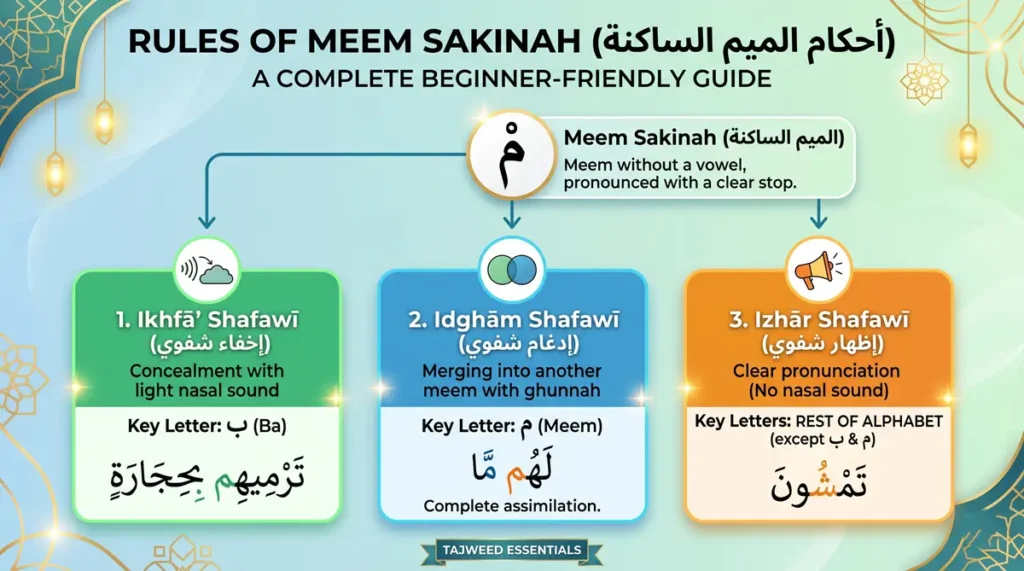
Rules of Meem Sakinah (أحكام الميم الساكنة): A Complete Beginner-Friendly Guide Meem Sakinah (الميم الساكنة) refers to the Arabic letter م (meem) that...