If you have any questions
Don’t hesitate to reach out to us via live chat or email!
Prayer is one of the most important aspects of Islam, and it is the cornerstone of a Muslim’s daily life. Muslims are required to perform five daily prayers, also known as Salah, and it is an essential part of the faith. Prayer is a way for Muslims to connect with Allah (God), to seek guidance, and to ask for forgiveness. In this blog post, we will discuss how to perform prayers correctly, step-by-step.
In This Article
ToggleBefore beginning Salah, it is important to make the intention or Niyyah. The intention is the inner commitment or resolve to perform the act of worship for the sake of Allah alone. The intention is not verbalized, but it is made in the heart with sincerity and purity of intention. The Prophet Muhammad (peace be upon him) said, “Actions are judged by intentions, and every person shall have what they intended” (Sahih Bukhari).
Making the intention before Salah helps to increase the focus and concentration during the prayer. It also reminds us of the purpose of Salah, which is to worship Allah and seek His pleasure. The intention can be made in any language, as it is a matter of the heart and sincerity.
It is important to note that the intention should not be made for the sake of showing off or seeking praise from others. The intention should be solely for the sake of Allah and seeking His reward.
In conclusion, making the intention before Salah is a crucial step in performing the prayer correctly. It helps to increase the sincerity and focus during the prayer and reminds us of the purpose of Salah. May Allah accept our intentions and make our prayers a means of drawing closer to Him.
Before performing Salah, Muslims are required to perform Wudu, which is an act of purification. Wudu is performed by washing certain body parts in a specific order, and it is necessary to ensure that a Muslim is in a state of cleanliness before standing before Allah. Here is how to perform Wudu:
Begin by making the intention to perform Wudu for the sake of Allah.
Wash your hands three times, starting with the right hand.
Rinse your mouth three times.
Clean your nostrils by sniffing water into them and blowing it out three times.
Wash your face three times, from the hairline to the chin and from ear to ear.
Wash your arms up to the elbow three times, starting with the right arm.
Wipe your head once with wet hands, from the forehead to the back of the head and back to the forehead.
Wash your feet up to the ankles three times, starting with the right foot.
After performing Wudu, Muslims need to prepare for Salah by finding a clean and quiet place to pray. It is also important to ensure that the clothing is clean and modest. Here is how to prepare for Salah:
Make sure you are facing the Qiblah (the direction of the Ka’bah in Mecca).
Stand up straight, with your feet shoulder-width apart.
Raise your hands to your shoulders, with palms facing forward, and say Allahu Akbar (Allah is the greatest).
Place your right hand over your left hand on your chest.
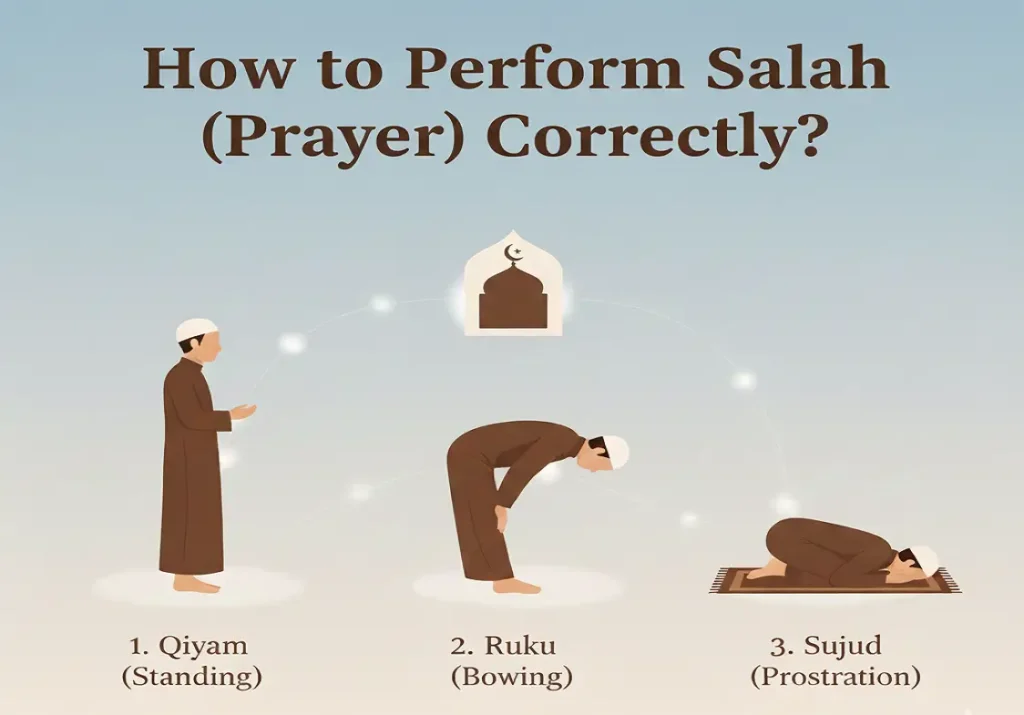
Now that you have performed Wudu and prepared for Salah, it is time to perform the actual prayer. Here are the steps to follow:
Recite Surah Al-Fatihah (the first chapter of the Quran) silently to yourself.
Recite another Surah or part of one.
Raise your hands to your ears and say Allahu Akbar.
Bow down, with your hands on your knees, and say Subhana Rabiyal Azeem (Glory be to my Lord, the Great).
Stand up straight, with your hands by your side, and say Sami Allahu liman hamidah (Allah hears those who praise Him(.
Raise your hands to your ears and say Allahu Akbar.
Prostrate, with your forehead, nose, hands, knees, and toes touching the ground, and say Subhana Rabiyal A’la (Glory be to my Lord, the Most High).
Sit up straight, with your left foot under your body and your right foot pointing forward, and say Rabbighfirlee (O Allah, forgive me).
Prostrate again, and say Subhana Rabiyal A’la.
Stand up straight, with your hands by your side, and say Allahu Akbar.
Repeat steps 3-10 to perform the second and third Rak’ah
After performing the final Rak’ah, sit down and recite the Tashahhud, which is a declaration of faith and a testimony to the oneness of Allah.
After reciting the Tashahhud, send blessings upon the Prophet Muhammad (peace be upon him) by reciting the Darood.
Finally, turn your face to the right and say Assalamu alaikum wa rahmatullah (Peace and mercy of Allah be upon you) and then turn your face to the left and repeat the same phrase.

After completing the Salah, it is recommended to make a closing supplication or Dua. This is an opportunity to ask for forgiveness, seek guidance, and make requests to Allah. Here is an example of a closing supplication:
“O Allah, forgive me, have mercy on me, guide me, protect me, and grant me Jannah (Paradise).”
It is also recommended to make additional supplications and recite Quranic verses after completing the Salah.
Learn the meaning of the Arabic words in Salah. It is important to understand what you are saying during Salah to increase the focus and concentration.
Recite Quranic verses and supplications during Salah. This helps to increase the connection with Allah and make the prayer more meaningful.
Avoid distractions during Salah. Find a quiet place to pray and turn off your phone and other distractions.
Dress modestly and ensure that your clothing is clean and free from impurities.
Perform Wudu properly and ensure that you are in a state of cleanliness before starting Salah.
Make a conscious effort to concentrate during Salah and avoid rushing through the prayer.
Attend congregational prayers in the mosque whenever possible. Praying in congregation is highly encouraged in Islam and it helps to increase the sense of community and brotherhood.
In conclusion, Salah is an essential aspect of the Muslim faith, and performing it correctly is of utmost importance. Following the steps outlined in this blog post can help to ensure that Salah is performed in the correct manner. It is also important to maintain a consistent prayer routine and strive to improve the quality of Salah over time. May Allah accept our prayers and make us among those who are successful in this life and the Hereafter.
If you have any questions
Don’t hesitate to reach out to us via live chat or email!