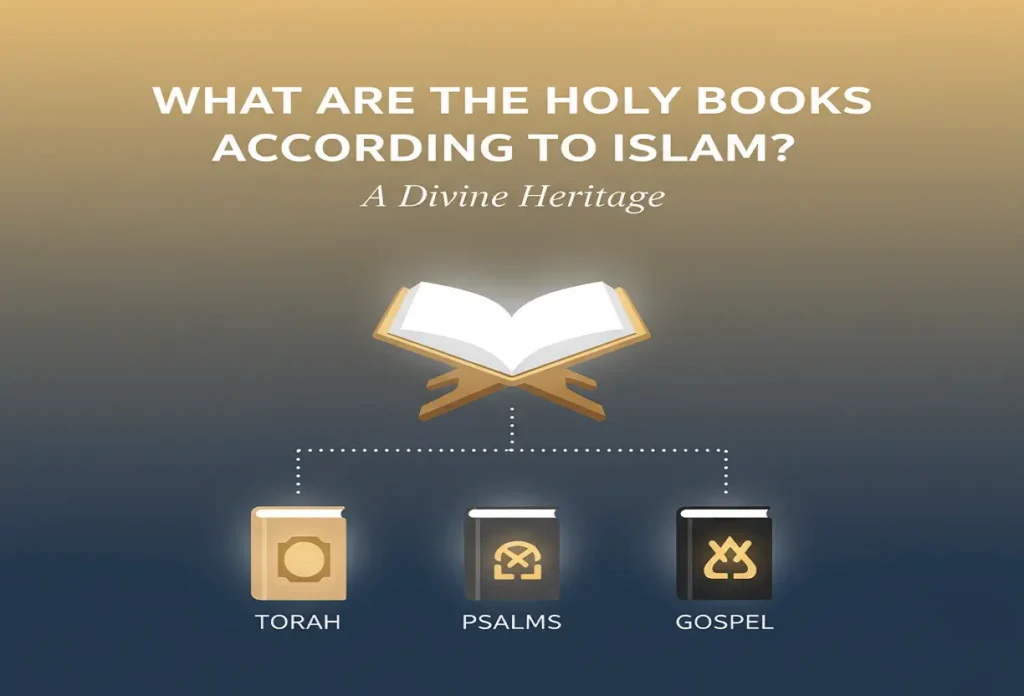
Muslims believe that certain religious texts known as holy books have genuine divine significance because God (Allah), through various prophets and messengers, including those who came before the Quran, wrote them. The three religious texts that are mentioned explicitly by name in the Quran are the Tawrat, which was received by prophets and messengers among the Children of Israel, the Psalms, which David received; and the Gospel, which Jesus received. The Quran also mentions God revealing the Torah and the Scripture to Abraham and Moses.
Muslims believe that the Quran, in the form in which it was revealed to Muhammad, is God’s final revelation to humankind and, as such, completes and confirms earlier writings, such as the Bible. One of the six Islamic articles of faith is the validity of earlier Abrahamic scriptures, even though Muslims prioritize the Quran in this context. The idea of tahrif (distortion), however, limits the extent of this belief for the majority of self-identified Muslims.
The Quran, which Muslims consider to be a revelation from God (Allah), is the central religious text of Islam. The chapters (surah) of the Quran are further broken down into verses (ayah). Muslims hold that over the course of about 23 years, beginning in late 609 when Muhammad was 39 and ending in 632, the year of his death, Allah verbally revealed the Quran to Muhammad through the angel Gabriel (Jibril). Muslims view the Quran as Muhammad’s greatest miracle, evidence of his prophethood, and the culmination of a lineage of divine revelations that began with the revelations to Adam and ended with Muhammad. It is frequently cited as the best piece of traditional Arabic literature.
2- Tawrat (Torah)
The Arabic term “Tawrat” (also Tawrah or Taurat; Arabic: ) refers to the Torah in the context of Islam as a holy book that Muslims believe was given by God to the prophets and messengers among the Children of Israel. Muslims have dealt with the Pentateuch, the other books of the Hebrew Bible, as well as writings from the Talmud and the Midrashim to refer to traditions from the Tawrat.
3- Zabur (Psalms)
The Zabur, also known as the Book of Psalms, is referred to in the Quran as the holy text that was revealed to King David (Dawud). The Psalms have frequently been interpreted by scholars as holy songs of adoration rather than as a legal code. Many Muslim scholars still give the current Psalms high praise. Psalm 37:29 and Quran 21:105 are parallel passages. But we can’t approve that the Psalms that we have nowadays are the same book Prophet David received.
4- Injil (Gospel)
According to the Quran, the holy book revealed to Jesus (Isa) was the Injil. Most scholars and Muslims believe that the Injil refers to an original Gospel that was given to Jesus as the word of Allah rather than the entire New Testament, even though some lay Muslims think it refers to the entire New Testament. Therefore, the gospel was the message that Jesus, being inspired by God, preached to the Children of Israel, in accordance with Muslim belief.
Other scriptures
Two ancient scrolls and perhaps another book are also mentioned in the Quran:
Scrolls of Abraham
The Scrolls of Abraham (Arabic:suhuf Ibrhim) are thought to be among the earliest canons of scripture. They are said to have been given to Abraham (Ibrhim), and later used by Ishmael (Isma’il), and Isaac (Isaq). Many translators have rendered the Arabic suhuf as “books,” despite the word being more frequently translated as “scrolls.” The verse that refers to the “Scriptures” calls them “Books of Earlier Revelation” along with the Scrolls of Moses is in the Quran 87:18–19.
Scrolls of Moses
The Quran makes two mentions of the Scrolls of Moses (Arabic: صُحُفِ مُوسَىٰ, Ṣuḥuf Mūsā), an ancient collection of texts. They are a part of Islam’s religious writings. According to Jordanian philosopher and scholar Ghazi bin Muhammad, the Torah of Moses and the “Scrolls of Moses” are the same, and this is what considered acceptable by most of scholars. Others have suggested that they might be alluding to Tanakh in the Book of Numbers or the Book of the Wars of the Lord, a lost text mentioned in the Old Testament. The verse referring to the “Scriptures” is found in Quran 87:18–19, stating that they were “Books of Earlier Revelation” alongside the Scrolls of Abraham.
John the Baptist's Book
According to the Qur’an, Prophet John received knowledge and a book (the “Kitab”):
(To his son came the command): “O Yahya (John)! take hold of the Book with might”: and We gave him Wisdom even as a youth.”. And Scholars pointed out that it’s the Torah of Moses.
The importance of holy books and the necessity of believing in them
God Almighty revealed the holy books to His servants of prophets and messengers to urge people to unite the All-Powerful God, give up idolatry and other-than-God belief systems, practice good deeds and obedience, and abstain from all sin and disobedience.
Every Muslim must believe in all of the holy books mentioned in the verses of the Holy Qur’an because the Islamic faith also requires belief in all of the messengers and prophets mentioned in the Holy Qur’an as well as belief in the religious teachings that were revealed to them. Allah said in the Surat- Alshura: 13: He has ordained for you of religion what He enjoined upon Noah and that which We have revealed to you, [O Muhammad], and what We enjoined upon Abraham and Moses and Jesus – to establish the religion and not be divided therein. Difficult for those who associate others with Allah is that to which you invite them. Allah chooses for Himself whom He wills and guides to Himself whoever turns back [to Him].
Faith in the divine books is part of faith in the Holy Qur’an, and part of faith that God Almighty is the Guide, for there is no nation except that God has sent down guidance for it. The Muslim believes that the Qur’an includes all the books that preceded it and is free from distortion. The Qur’an confirms the previous books and is the only reference for clarifying what is true in them.
A Muslim should take a position about these books, the Torah and the Gospel, to believe in what is stated in them and what the Holy Qur’an has decided and doesn’t contradict its origins. Other than that including the stories and sermons that the Qur’an did not mention and do not contradict its origins, he does not believe or deny them.
Heavy and Light Letters in Arabic (Tafkhīm and Tarqīq): A Complete Beginner-to-Advanced Guide Introduction: Why Heavy and Light Letters Matter When a...
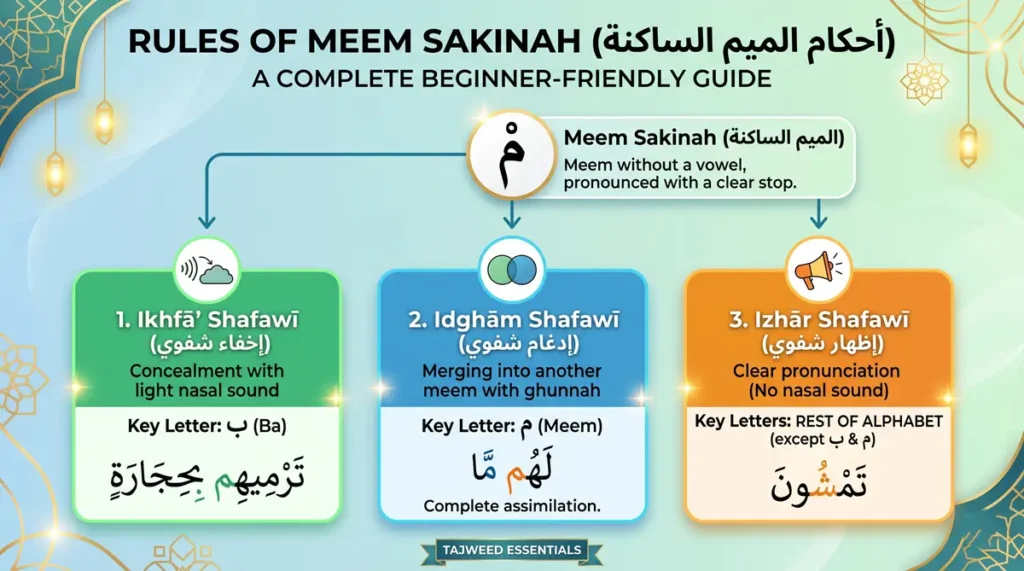
Rules of Meem Sakinah (أحكام الميم الساكنة): A Complete Beginner-Friendly Guide Meem Sakinah (الميم الساكنة) refers to the Arabic letter م (meem) that...