Ayat Academy

The Quran is the greatest miracle for what reason?

Quran is the greatest miracle

Introduction

Allah commissioned the Prophet Muhammad (ﷺ) with a universal message of guidance for all humanity. As is the tradition with all Messengers, divine miracles were granted as evidentiary support to establish their truth. For the Final Prophet, the primary and eternal miracle is the Holy Quran—a multidimensional marvel that continues to offer profound arguments to every generation.

The verses of the Noble Quran are replete with linguistic, scientific, and historical miracles. As we delve deeper into its structural and semantic layers, we uncover the vast diversity and precision of these signs, which distinguish it from any human composition.

The miracle is distinguished by a few key traits, including:

  1. Recently happened

To be a fresh occurrence that exists only in the present.

  1. An odd thing or circumstance

In other words, to be something unusual. It is not a miracle to put out a fire with water, but it is a miracle to keep it from going out.

  1. At the time of commissioning, The Miracle occurred.

That it takes place during the time of the assignment, i.e., before the resurrection in this life for which people will be held accountable, and that the ink has yet to run dry because we are outside the period of assignment framework.

  1. Linked to a plea for religious piety as evidence

The miracles that the Noble Quran told us about, and with which God sent the Messengers, are divided into two parts.

Tangible and intangible

It refers to whether or not the miracle can be seen with the naked eye. Tangible means the obviously visible miracles, which are frequently fleeting since they occur as a result of the da’wah and are witnessed by the people as immediate evidence of the veracity of the message before disappearing as a result of the Messenger’s departure and death.

The Quran is a miracle in itself due to its:

Textual content

The phrase and its intended meaning are consistent, just as there is consistency between the letters in a word and the words in a sentence.

Distinct Quranic style

The Holy Quran stands out for its adaptability and conformity to interpretation, and its adaptability is exemplified by the fact that it cannot contain any contradictions.

Therefore, the Holy Quran’s style cannot be compared to any other.

As well as bridging the gap between the simple spirit and its deep interior, which satisfies the philosophers’ thirst for more excellent knowledge and thought, it also incorporates inspiring, intimidating, and stunning beauty in its expressions.

” إِنَّ رَبَّكَ سَرِيعُ الْعِقَابِ وَإِنَّهُ لَغَفُورٌ رَّحِيمٌ” الأنعام 165

“Indeed, your Lord is swift in punishment, and He is Oft-Forgiving, Most Merciful.”

Quran 6: 165 

The solidity of the Quranic framework

It entails picking out letters and words, moving between them, and arranging them in a particular context that directs the meanings in the best possible context and with the most appealing composition.

Allah Almighty said: 

وَلَئِن مَّسَّتْهُمْ نَفْحَةٌ مِّنْ عَذَابِ رَبِّكَ لَيَقُولُنَّ يَٰوَيْلَنَآ إِنَّا كُنَّا ظَٰلِمِينَ

(الأنبياء – 46)

And if a whiff of your Lord’s punishment touches them, they will say, “Woe to us! Indeed, we were unjust .”

quran 21:45

The degree of human weakness was demonstrated by using the phrase “whiff” to describe something as only a tiny source of suffering.

Historical Quranic miracles

The fact that the Quran discussed civilizations that no one was aware of at the time of its revelation is one of the wonders of the book.

These freshly found civilizations are exactly like those described in the Quran.

For instance:

1- The “Thamud” civilization

God Almighty described the Thamud culture, notable for carving homes into mountains, a characteristic uncommon in the Arabian Peninsula. After thousands of years, structures from this era were uncovered. Indeed, as entirely detailed in the Quran, the houses were cut out of the rocks.

2- The narrative of Prophet Musa 

Prophet Musa’s (peace be upon him) life biography and the historical incidents it encompassed are recorded by God in His Noble Book.

We discover that the monarchs of Egypt during this time were referred to in the Quran as “Pharaohs,” a term that had already been used to refer to kings in ancient Egypt, and they believed themselves to be gods.

3- Musa’s Mountain. 

Mount Musa was mentioned in the Quran as being on the Sinai Peninsula, and after thousands of years, researchers have established that it is in fact on the Red Sea’s Arab shore.

4- The word “Haman”

Before the eighteenth century, when Egyptian hieroglyphs were deciphered, the name “Haman” was unknown.

Haman was revealed to be a close advisor to the pharaoh on the “Quarry Head” after the hieroglyphs were deciphered.

However, the remarkable thing is that hundreds of years before this was realized, Haman was identified in the Quran as the one who oversaw the building project under the pharaoh’s direction.

What are the Quran's scientific miracles?

In the Qur’an, there are numerous scientific wonders. A few of the numerous scientific facts referenced in the Quran were briefly mentioned. Even though the Quran mentions certain scientific facts, it is not a science book. 

  • The Universe’s expansion

We can infer that the cosmos is expanding from Einstein’s equations. Everyone was astonished by this finding.

Scientists believe that the cosmos erupted after the Big Bang and has been slowing down ever since. They erred, however. The expansion of the cosmos has recently accelerated. What we refer to as dark energy is what is causing this enigmatic re-expansion. This strange anti-gravity started pushing the universe forth again some 5 billion years ago.

This is properly described in the Holy Quran:

وَالسَّمَاءَ بَنَيْنَاهَا بِأَيْدٍ وَإِنَّا لَمُوسِعُونَ

And We have built the heaven with might and We continue to expand it indeed.

Holy Quran 51:48

This astounding verse reveals more than just the universe’s expansion. The Arabic word ‘la-mūsiʿūna’ informs us that the universe is still expanding.

  • The Universe’s Final Days

Not only does the Quran discuss hitherto undiscovered topics. Instead, it provides information about scientific phenomena that are still up for debate. Even though the next two have only been discussed, they deserve attention.

The universe’s end is one such subject. If it keeps growing, will it eventually stop or will it eventually contract again? This puzzling topic is clarified by the Holy Quran:

یَوۡمَ نَطۡوِی السَّمَآءَ کَطَیِّ السِّجِلِّ لِلۡکُتُبِ ؕ کَمَا بَدَاۡنَاۤ اَوَّلَ خَلۡقٍ نُّعِیۡدُہٗ ؕ وَعۡدًا عَلَیۡنَا ؕ اِنَّا کُنَّا فٰعِلِیۡنَ

“Remember the day when We shall roll up the heavens like the rolling up of written scrolls by a scribe. As We began the first creation, so shall We repeat it — a promise binding upon Us; We shall certainly perform it.”

Holy Quran
21:105

The world crashing into a black hole is perfectly illustrated by this vivid Quranic narrative. The spacetime fabric would enclose it like rolls of parchment due to angular momentum. A new universe would then manifest.

Latest Articles

Heavy and Light Letters in Arabic (Tafkhīm and Tarqīq): A Complete Beginner-to-Advanced Guide
Heavy and Light Letters in Arabic (Tafkhīm and Tarqīq): A Complete Beginner-to-Advanced Guide Introduction: Why Heavy and Light Letters Matter When a...
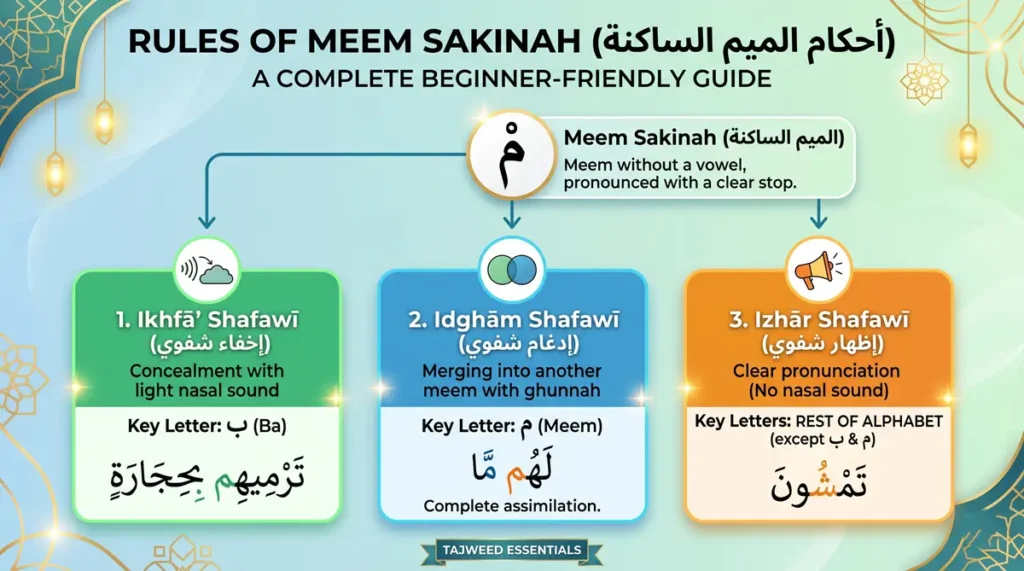
Rules of Meem Sakinah (أحكام الميم الساكنة): A Complete Beginner-Friendly Guide
Rules of Meem Sakinah (أحكام الميم الساكنة): A Complete Beginner-Friendly Guide Meem Sakinah (الميم الساكنة) refers to the Arabic letter م (meem) that...
The Rules of Ikhfa and Iqlab of Noon Sakinah and Tanween in Tajweed
The Rules of Ikhfa and Iqlab of Noon Sakinah and Tanween in Tajweed – Beginner’s Guide The Qur’an is the final revelation from Allah ﷻ to...

If you have any questions

Don’t hesitate to reach out to us via live chat or email!