Ayat Academy

What are the 6 pillars of faith?

6 pillars of faith

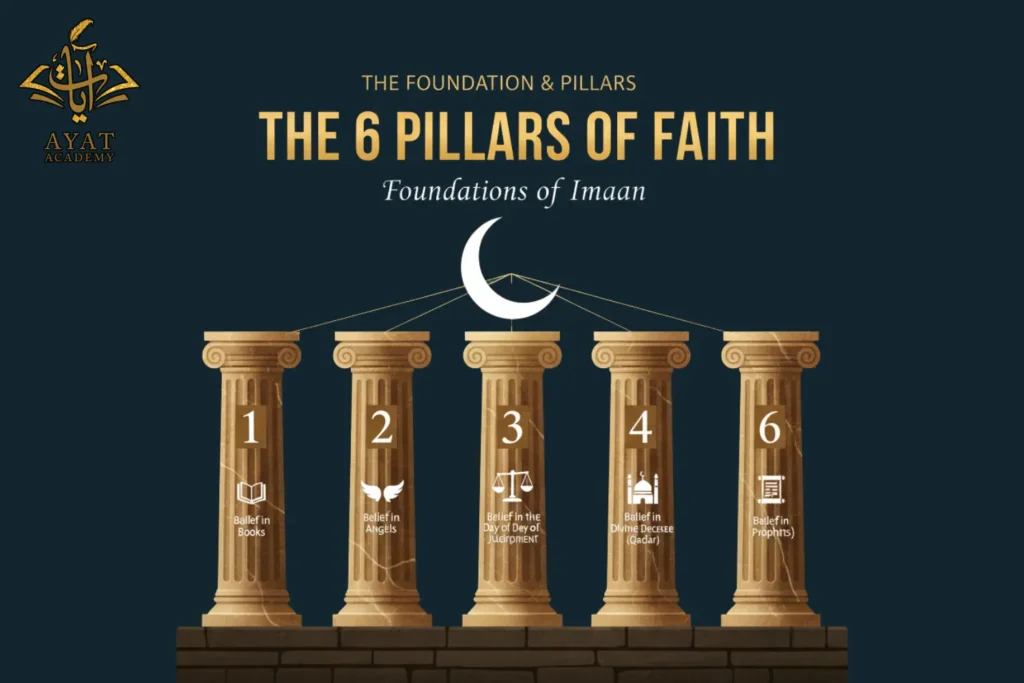
There are six articles of faith (Imaan), which essential components of a Muslim’s life. The following verse from the Quran emphasizes their significance:

O you who believe! Keep faith in Allah and His Messenger and the Book which He revealed to His Messenger, and the Book which He revealed before. Whoso disbelieves in Allah, His angels, His Books, and His Messengers and the Last Day, he verily has wandered far astray.[Quran, 4:136]

In the following Hadith, as well:

“…What is Belief?

The Prophet ﷺ said, ❝Belief is to believe in Allah, His Angels, His Books, His Apostles, and the meeting with Him, and to believe in the Resurrection.❞ [Sahih Al Bukhari]

Let's discuss about the 6 pillars of faith:-

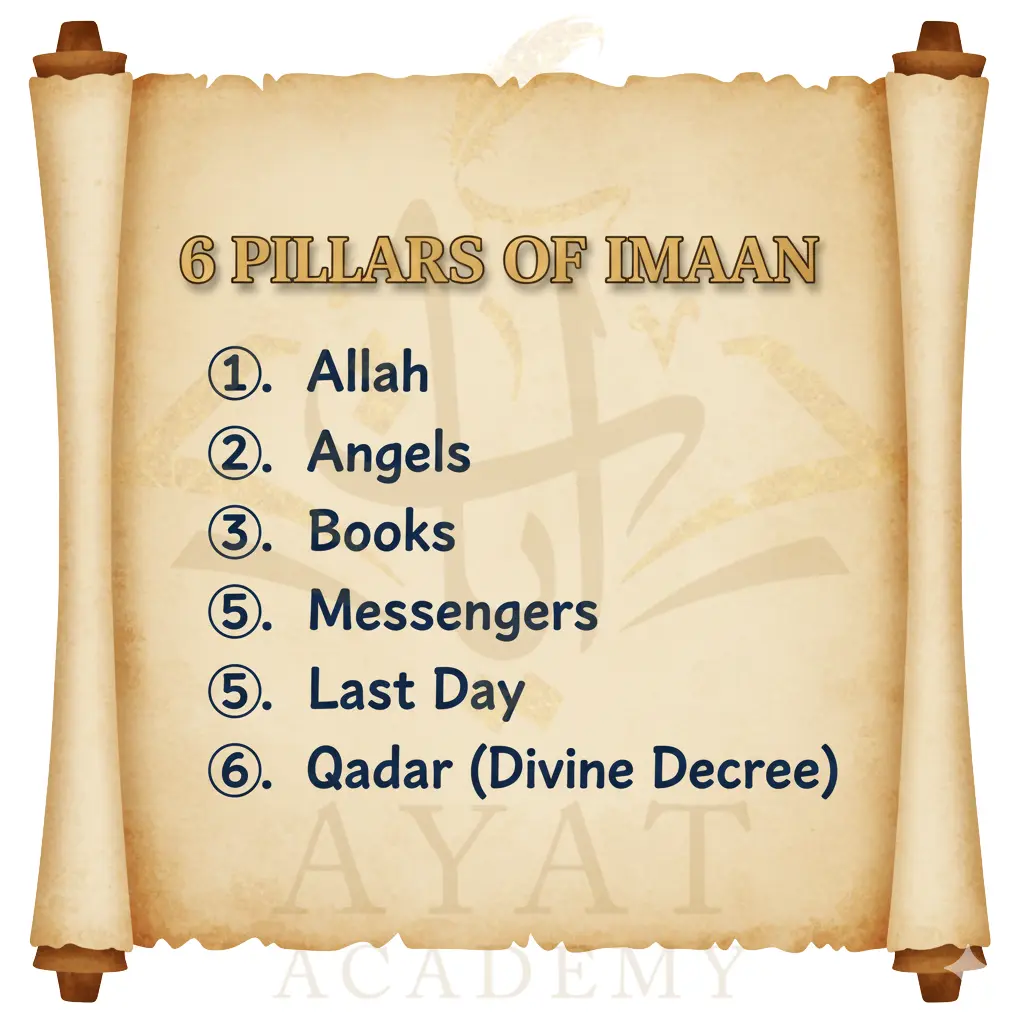
1- Belief in Allah

A belief in Allah is that there is only one true God, devoid of a son or partner, worthy of worship. Tawheed is the name given to this idea. It also means fully accepting the way He is portrayed in the Quran, the Sunnah, and His 99 names.

In the Holy Qur’an, Allah provides a clear explanation of Tawheed, saying,

 ❝Say: He is Allah, the One. Allah, the Eternal Refuge. He neither begets nor is born, nor is there to Him any equivalent.❞ [Quran, 112:1-4]

2- Belief in His Angels

The angels are created from light and are messengers of Allah. They were created before humans to worship and submissively obey Allah.

Angels do not need to eat, sleep, or get illnesses. It is essential to have faith in angels. They do other responsibilities, including blowing the trumpet on the Day of Judgment, taking people’s souls (i.e., being the angel of death), and guarding heaven and hell.

❝Who so disbelieves in Allah, His angels, His Books, and His Messengers and the Last Day, he verily has wandered far astray.❞ [Quran, 4:136]

3- Belief in His books

Allah gave books to his messengers as a means of instruction and evidence for people. The Quran, which was revealed to Prophet Muhammad, is one of these books. Allah has promised to guard the Quran against any tampering or corruption. The books sent and made available to man are:

1- Ibrahim’s Scrolls (Suhof)

2- The Zaboor (Psalms) that was sent with the Prophet Dawud (David),

3- The Gospel (Injeel) was sent with Prophet Isa, and the Torah (Torah) was sent with Prophet Musa (Moses) 

4- The Injeel (Gospel) that was sent with Prophet Isa (Jesus),

5- The Qur’an, which was sent with the Prophet Muhammad.

Muslims hold a belief in every book that the prophets received revelation for. But because the Quran is the last revealed book, they abide by its laws only and try to live by them as God and the prophet Muhammad commanded.

❝Indeed, it is we who sent down the Qur’an and indeed, we will be its guardian.❞ [Quran 15:9]

4- Belief in His messengers

Allah sent messengers and prophets to preach the same message—that there is only one God—and to lead their peoples to Islam. All messengers are humans.

❝And we indeed sent into every nation a messenger, [saying], “Worship Allah and avoid Taghut.” And among them were those whom Allah guided, and among them were those upon whom error was [deservedly] decreed.❞ [Quran, 16:36]

The Quran mentions 25 prophets, including Adam, Idris (Enoch), Nuh (Noah), Hud (Heber), Salih (Methusaleh), Lut (Lot), Ibrahim (Abraham), Ismail (Ishmael) ,Ishaq (Isaac), Yaqub (Jacob), Yusuf (Joseph), Shu’aib (Jethro), Ayyub (Job), Dhulkifl (Ezekiel), Musa (Moses), Harun (Aaron), Dawud (David), Sulayman (Solomon), Ilias (Elias), Alyasa (Elisha), Yunus (Jonah), Zakariya (Zachariah), Yahya (John the Baptist), Isa (Jesus), Muhammad (PBUH).

Except for Prophet Muhammad, who was sent to lead all of humanity, most of Allah’s messengers were sent to a particular nation. Muslims have to say salaam, or “peace and blessings of Allah,” whenever one of the Prophets is mentioned.

5- Belief in the last day (Hereafter)

Muslims must believe that there is an afterlife where all our deeds, big or small, will be judged. Only Allah knows the exact date of this day, so we must constantly strive for excellence.

Muslims also believe that there is a place called heaven and a place called hell and that our final destination will depend on our actions during this life.

❝And we place the scales of justice for the Day of Resurrection, so no soul will be treated unjustly at all. And if there is [even] the weight of a mustard seed, we will bring it forth, and sufficient are we as an accountant.❞ [Quran, 21:47]

6 Pillars of Imaan

6- Belief in the Qadar (Divine Decree)

Everything that occurs is a result of Allah’s will and command. But Muslims also acknowledge that they have been endowed with free will and the capacity to distinguish between good and evil. 

Four things are included in the belief in divine predestination:

  1. Allah made everything.
  2. Allah is aware of both the past and the present.

3- A record of everything that has occurred and will take place exists.

  1. Whatever Allah orders to happen will happen. Anything that Allah wants not to happen doesn’t.

❝Do you not know that Allah knows what is in heaven and earth? Indeed, that is in a Record. Indeed that, for Allah, is easy.❞ [Quran, 22:70]

The Messenger of Allah () said: ‘No slave truly believes until he believes in four things: in Allah alone with no partner; that I am the Messenger of Allah; in the resurrection after death; and in the Divine Decree (Qadar).❞

Sunan Ibn Majah

No matter how difficult the circumstances, we must always put our faith in Allah and His will.

May Allah SWT bolster our imaan and consistently lead us in the right direction. Ameen.

Latest Articles

Heavy and Light Letters in Arabic (Tafkhīm and Tarqīq): A Complete Beginner-to-Advanced Guide
Heavy and Light Letters in Arabic (Tafkhīm and Tarqīq): A Complete Beginner-to-Advanced Guide Introduction: Why Heavy and Light Letters Matter When a...
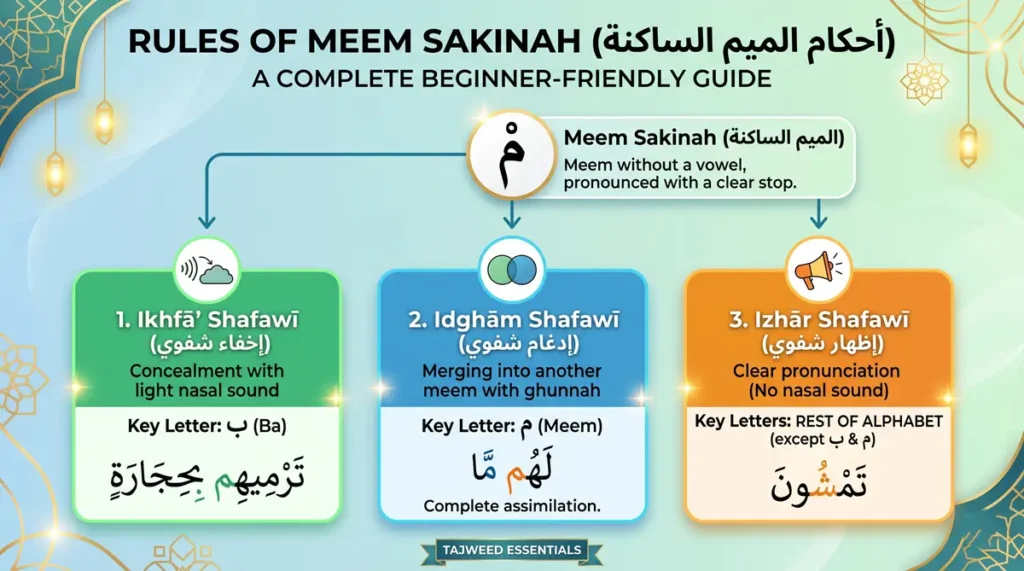
Rules of Meem Sakinah (أحكام الميم الساكنة): A Complete Beginner-Friendly Guide
Rules of Meem Sakinah (أحكام الميم الساكنة): A Complete Beginner-Friendly Guide Meem Sakinah (الميم الساكنة) refers to the Arabic letter م (meem) that...
The Rules of Ikhfa and Iqlab of Noon Sakinah and Tanween in Tajweed
The Rules of Ikhfa and Iqlab of Noon Sakinah and Tanween in Tajweed – Beginner’s Guide The Qur’an is the final revelation from Allah ﷻ to...

If you have any questions

Don’t hesitate to reach out to us via live chat or email!